

I never tire of learning about women who defy the constraints of patriarchy.
Sarah Lonsdale’s recently published book Wildly Different is about five wonder women. None had a cape or superpowers, rather they had an unbreakable drive to be one with Nature and to protect Her.
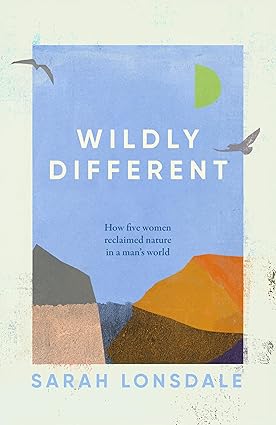 Lonsdale shares the full span of these women’s lives and their resolute relationship with nature and the natural environment. Their wills and inner compasses were so strong and focused, that they would not be doused or derailed by those trying to hold them back.
“This book is about five of these women, whose lives spanned the last 150 years, and who, each in her own way, challenged centuries of myth, superstition and tradition for her place in nature”(Lonsdale 11).
Immersed in the details of these women’s lives, I was repeatedly reminded of what many say about bravery: being brave doesn’t mean one is not afraid, it means that the person doesn’t let fear stop them.
By heeding their call to the wild, these women experienced an exhilarating freedom most of us will never know.
“Thus, the wild also represents freedom, if you are brave enough to take it, from human rules, many, as we know, drawn up through prejudice, fear or folly”(Lonsdale).
I had heard of one of these women, Wangari Maathai, a Kenyan environmentalist and 2004 recipient of a Nobel Peace Prize. I hadn’t heard of the others and honestly didn’t know much about Wangari either.
After reading Lonsdale’s book, these women, their feats, and legacies will stay with me always.
Here is a slice of these women’s stories to whet your desire to learn more!
Mina Benson Hubbard, Canadian, 1870-1956

This woman set out to finish what her husband, Leonidas Hubbard, was unable to complete: the exploration and mapping of the wilds of Labrador, Canada.
Mina’s decision to complete her husband’s ill-fated expedition was met with disbelief and hostility. This is not what a woman was designed or destined to do, especially in 1905. None of this judgment, discouragement, and lack of support would hold Mina back from doing what she was called to do. Many believed her to be an unhinged, grieving widow, but she knew what she was capable of and was clear on why she was making this journey.
Lonsdale describes some of Mina’s experience:
“Her response to the wilderness is the complete opposite of Leonidas’s: where he found nastiness and adversity, she finds deep connection with the natural world. When the canoes seemed to lose themselves down between the big grey waves of Lake Michikamau, she wasn’t afraid; instead, the ‘sense of littleness grew upon me’ and made her able to appreciate the magic of being ‘deep in the wilderness’ all the more. She surrenders to it. There is a sense that she is re-writing Leonidas’s experience of the wilderness and thereby finds redemption for the both of them”(26).
To honor her late husband and to prove she could do the job as well as a man, she labors to create a most precise map:
“Mina’s map was published in the American Geographical Society Bulletin in 1906, earning it the imprimatur of being the official account, and a testament to the care and accuracy of her work”(127).
Mina’s book A Woman’s Way Through Unknown Labrador was published in 1908.
Come to know this woman, Mina Benson Hubbard, in Lonsdale’s Wildly Different.
Evelyn Cheesman, British, 1881-1969

Readers meet this self-taught entomologist as she’s tangled in a giant spider web on one of her seven expeditions to collect yet-identified plants and insects. This terrifying conundrum and how she escapes are not easily forgotten!
Not allowed to enroll in veterinarian school as a woman, she takes the entomology route, working as a volunteer in a natural history museum, and eventually permitted on expeditions to remote areas of the world.
I have never read about anyone who worked as tirelessly as Evelyn to get where she wanted to go and to do what she wanted to do. Money is a perennial issue for her and at one point she borrows a colleague’s microscope while he is on his lunch break so she can further her work. She did not give up, despite incredible odds. She threw herself entirely into her work, while at home and away, and only became more enchanted.
“Climbing a cliff in Tahiti, Evelyn noted that, “The beauty was intoxicating; she stopped every few minutes to take it all in, enchanted. She later wrote that she felt ‘at one with all nature, part of the calm landscape and the friendly birds, as if with a finger on mother earth’s pulse one felt the movements of that mighty heart of hers’. She became aware of her insignificance, ‘one atom … in the vast universe’, but it made her strong, not lonely”(47).
No matter the barrier, this woman is unstoppable and does not come home empty-handed:
“In 1934 she returned briefly with 42,000 insects for the Natural History Museum, and to have her portrait taken by the News Chronicle, before heading back to continue her work”(165).
Her work and expeditions continued for another twenty years and she contributed 70,000 specimens, some still being identified by scientists to this day. In addition to plants and insects, Evelyn also detected through her observation and research that something big must have occurred with the earth at one point:
“Always having had to challenge tradition and rigid thinking: from the admissions office at the Royal Veterinary College, the naysayers at London Zoo to His Majesty’s representatives on their isolated dominions, Evelyn now challenged paleogeologists to reassess their assumptions on the history of how the earth was formed”(166).
Come to know this woman, Evelyn Cheesman, in Lonsdale’s book Wildly Different.
Dorothy Pilley, British, 1894-1986

Born in London, England, Dorothy was always drawn to being outside and the freedom experienced in nature. She had an adverse reaction to being told what to do, especially informed over and over again that marriage was her destiny. Soon, the mountains and their peaks would speak to Dorothy. They beckoned her and challenged her, and she bravely responded.
“Discovering the hills had been a happy accident. Dorothy’s first close-up encounter with a mountain happened in September 1914, on her twentieth birthday, when her Aunt Clara took Dorothy and her cousin Elsie to Snowdonia for a fortnight…A week later, after a few tentative forays and soggy picnics, she went out late in the afternoon, alone: ‘Wander about and afterwards get caught in the twilight and have to come down the bare rock in the dark.’ This deliberate courting of physical danger, incomprehensible to many, was to Dorothy life-affirming. Not only life-affirming, but a rescue from the brink”(51).
Before this life-changing trip, Dorothy:
“suffered headaches, ‘all those black creatures which haunt me with a throbbing head’, fits, boils and black moods as she gradually realised that for a young woman in 1912, life would mean a continuous battle for even small freedoms. This experience, then, of the mountains, represented a small ray of light in a world she would describe as being ‘stuck in a dark sub-terranean cave’”(52).
This small ray of light expanded exponentially and climbing mountains became her salvation. Some of her ascents are so precarious that even reading about them is intimidating.
“‘This is life, adventure, joy’, she wrote in her journal. In the summer of 1919, she made her mark by becoming the first woman to climb the ‘Devil’s Kitchen’, a 300-foot-high chimney of dark, wet rock where the wind roars and groans, trapped inside the narrow rift between the slabs of Cwm Idwal in Snowdonia. Her picture appeared in the Daily Graphic, describing her as ‘Miss D. E. Pilley, the mountaineer’: not bad for being barely three seasons into her climbing career”(59).
Dorothy would make many more marks over a lifetime of coupling with mountain peaks and escaping the ‘dark subterranean cave’ of a narrowly prescribed life.
Come to know this woman, Dorothy Pilley, in Lonsdale’s Wildly Different.
Ethel Gallimore Haythornwaite, English, 1894-1986

“Ethel Mary Bassett Ward was born on 18 January 1894 at Grove Lodge, Millhouses, at the edge of nineteenth-century Sheffield. As a child she listened to the rooks’ harsh calls, sang to the trees and danced among the wildflowers, learning more about the magic of the world, she would later write, on day trips out to the moors than she ever found in fairy books”(73).
And the moors would save Ethel after her young husband is killed in France during WWI.
“After the emotional pain came the physical agonies ‘from nature all unfilled and grieving slow’. Yet gradually…Ethel began to walk out into the hills of her childhood, relishing the ‘heavy mile’, the ‘slanting balls that beat across my cheek with blasting blows’”(79).
These all-important walks with nature began to revive Ethel, but much of these outdoor spaces had become off-limits and this was distressing:
“‘Men lived here’, she declared, since the dawn of time, in country that was now fenced off by usurping landlords”(83).
Ethel believed that all people have a right to commune with and enjoy nature, especially after long days and weeks working in factories, sitting in classrooms, and confined to domestics. The countryside saved her, so she would dedicate herself to saving the countryside and others’ access to it.
“Over her life she would help preserve tens of thousands of acres of Peak District wilderness, from the soft contours of Dovedale in the south to peaty precipice-rimmed Kinder Scout. From the age of 30, every day of her long life she fought to save the Peak. She fought to save it because it had saved her, from the ‘hideous jangled nerves and ceaseless pain’ and the ‘black and starless wall’ that once made her wish, before she went to sleep each night, that she would not wake in the morning”(70).
Ethel made it her life’s mission to preserve as much of the countryside as she could, working with others to do so, day in and day out.
“In all, Ethel was instrumental in passing ownership of nearly 2,800 acres of formerly private Peak District hillside, woodland and farms to the National Trust, to be protected in perpetuity. Most of these parcels of land were purchased through fundraising campaigns”(175).
Come to know this woman, Ethel Gallimore Haythornwaite, in Lonsdale’s Wildly Different.
Wangari Maathai, Kenyan, 1940-2011

Born in the Nakuru District, in the Great Rift Valley of Kenya, Wangari excelled at school, demonstrating early on that she was extremely bright and capable, yet:
“Women were not supposed to study beyond school. They were the backbone of Kenyan farming society: they tended the crops in the field, fetched water and firewood, cooked and looked after children. They were kept deliberately under-educated. But Wangari was determined and confident, and a miraculous confluence of events, combining Britain’s withdrawal from its colonies, an Irish-American senator’s [John F. Kennedy] philanthropy and a Kenyan trade unionist’s [Tom Mboya] ingenious idea, provided the opportunity she had hoped for”(95).
Due to this initiative, Wangari was able to earn her bachelor’s and master’s degrees in biological sciences in the United States and “in 1971 became the first Kenyan woman to be awarded a doctorate”(102).
Back in her home country of Kenya:
“She saw that extractive, commercial farming practices, the immorality of landowners not recognising their responsibility to either the land or its people, and the loss of connection between humans and the natural world had wrought this ecological disaster on her once-fertile homeland. She also saw that women were the key to reversing the disaster, but that social, political and religious conditioning had rendered them powerless and stripped of agency. They walked further for increasingly unclean water; they worked harder for decreasing harvests and watched their children suffer and die from lack of nutritious food”(104).
Wangari determined to do something about this. In 1977, she started what continues to this day as the Green Belt Movement.
Challenging an authoritarian government and big business, Wangari continued her movement to save the forests and protect vulnerable women and children:
“In 1980s Nairobi, Wangari Maathai was about to enter her most difficult two decades. Although these years would make her widely known and admired in the global women’s and environmental movements…She would be imprisoned several times, beaten up by the security forces, and would eventually have to go into hiding”(186).
In 1982, Wangari decided to run for political office and therefore had to forfeit her position at the University of Nairobi, after which she was told she was ineligible to run due to a technicality. Not able to get her position back, she dedicated herself into the movement even more:
“This setback provided the impetus that transformed the Green Belt Movement from a fairly modest and small-scale operation into a nationwide and, eventually, continent-wide tree-planting programme”(191).
In 2004, when it was announced on television that Wangari was a recipient of a Nobel Peace Prize:
“‘There were some “Wows”, some gesticulating and some tears…Then Wangari simply and softly said: “I didn’t know anyone was listening”(221).
Come to know this woman, Wangari Maathai, by reading Lonsdale’s Wildly Different.
Author Dr. Sarah Lonsdale

Yes, someone is listening and sharing your stories, Mina, Evelyn, Dorothy, Ethel, and Wangari.
Sarah Lonsdale unites these women for their love of the wilderness, along with their courage and resilience. She masterfully relays their stories, from childhood to their passing, sharing their challenges, heartbreaks, revelations, and victories. Lonsdale leaves no rock unturned. It’s amazing.
Lonsdale is a journalist, writer, historian, and lecturer in Journalism at City, University London.
Wildly Different is Lonsdale’s third book, the others Rebel Women Between the Wars: Fearless writers and adventurers (2020) and The Journalist in British Fiction and Film: Guarding the Guardians from 1900 to the Present (2016).
Sarah Lonsdale is a Nasty Women Writer.
© Maria Dintino 2025, 2026
Works Cited
Lonsdale, Sarah. Wildly Different: How five women reclaimed nature in a man’s world. Manchester University Press, 2025.


 Donate

