
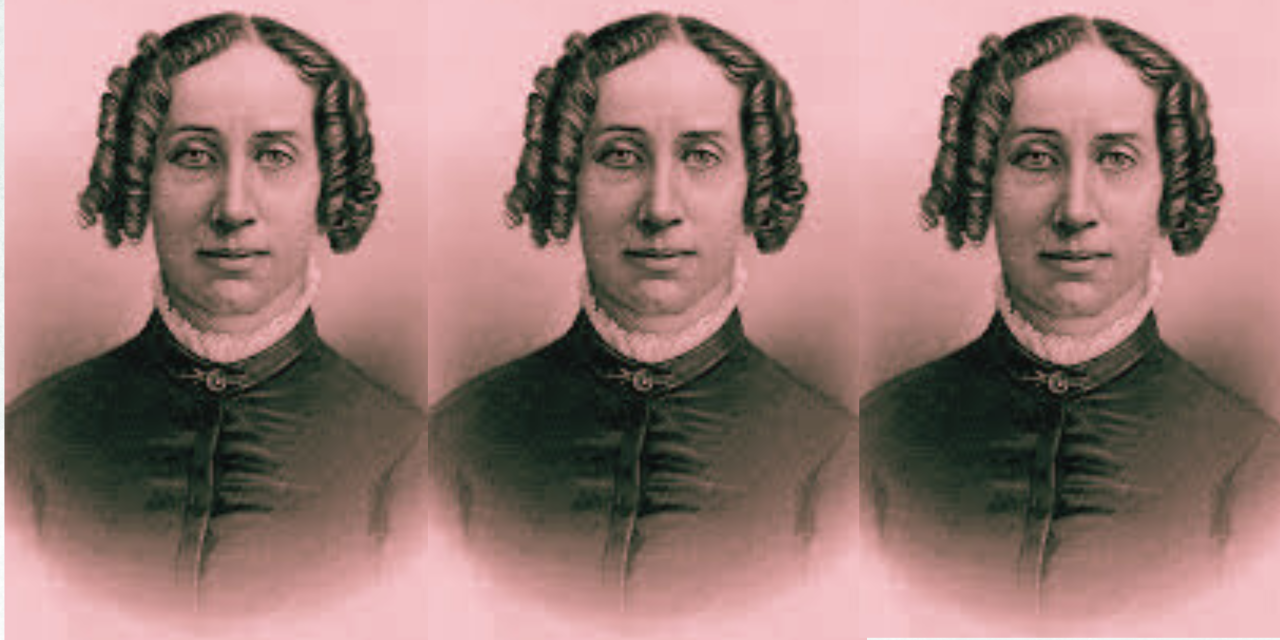
Numerous American women fought all of their lives for women’s rights, many of them around the time of abolition and what is often called the “first wave” of the women’s movement. This movement quickly became known mostly for suffrage because the big names in the movement eventually decided to focus solely on that. Suffrage is a big stepping stone on the way to any human’s liberation in a democracy. Having a vote means having a say. Having a say means being able to participate fully in who gets elected and creates the laws that govern the lives of those who live in said democracy.
In functioning democracies, voting is a big deal. Many women felt that to have any impact, they needed to have the vote. A lot of criticism has been directed toward these first-wave women’s rights leaders. Some of the criticism is well-founded and deserved. The leaders tended toward white supremacy, often sidelining African American and women of color in their tunnel vision ambition to gain the vote for white women. Also, their decision to focus solely on suffrage caused them to alienate other women’s rights activists, including white women, who held other issues dear to their hearts.
The time of Temperance, Abolition, and the budding women’s movement was an extremely complicated one in the history of the United States of America. Temperance, Abolition, and Women’s Rights ended up in competition with one another. Many of these groups fractured to get something achieved. Thus, when men abandoned the women’s causes to secure the vote for Black men, the women felt slighted. When women knew they couldn’t get all they wanted, they fractured their causes as well. We would be wise to learn the important lessons garnered from these fractures. However, it is also critical that we do not throw the baby out with the bathwater.
It must be acknowledged that even with all its flaws, without the first wave of the women’s movement, women may never have gotten the vote. Women like Susan B. Anthony and Elizabeth Cady Stanton gave their whole lives to the cause and never lived to be able to vote. Though they made a choice that many look back on now and criticize, their strategy did win the battle in the end. And we remember their names. Very few men are criticized for being single-minded to achieve a monumental goal.
Read Nasty Women Writers post on a sculpture in Central Park honoring Stanton, Anthony and Sojourner Truth:
Breaking the Bronze Ceiling: One Inspiring Public Sculpture at a Time
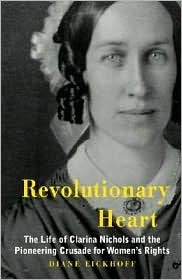 And then there are the overlooked women of the time, like Clarina Nichols who fought for women’s rights her entire life, only to see many of those she did achieve reversed in her lifetime. Still Clarina Nichols made a huge impact on her surroundings and the people she knew, encountered, educated and inspired. She was a powerhouse and worked relentlessly on the subject today termed: domestic violence. At the same time as Stanton and Anthony, she joined the cause of the women’s movement and was one of the main speakers and leaders. More recently, and thanks in part to biographer Diane Eickhoff, Nichols is receiving her due.
“During her long and productive career as a lecturer, activist, and journalist, Nichols collected stories of wives, widows, divorceés, and children who were put in harm’s way because of the legal system that failed to protect them. Whenever she spoke before a group or wrote an article for a newspaper, Nichols included stories that illustrated injustice. The widow sent to the poorhouse because the laws of her state did not permit her to collect her husband’s estate. The wife helpless to stop her spouse from spending all she earned on drink. The little boy left orphaned and penniless because his dying mother could not leave him an inheritance” (9).
Nichols fought for suffrage as well because she believed to change the reality of American women’s lives, one must change the laws that govern them and the only way to do that is to get women into positions of those who make the laws.
I am completely impressed by Nichols’ commitment, energy and drive and grateful for the work she did in her lifetime. She is also the grandmother of Grace Hudson, a Nasty Woman Artist covered in the post at the link below.
California Painter Grace Hudson (1865-1937): Honoring the Pomo People
Clarina Nichols the activist
Clarina Nichols wanted to make Americans aware of how injustice was written into the laws of our country. She argued publicly through speeches and written articles that Americans should be concerned about changing the laws so that women could take care of themselves if their husbands passed away, earn a living, and have rights to their own children. There were so many laws that were unfair to women or laws that were absent to protect women. She herself had been a victim of this .
Diane Eickhoff’s book, Revolutionary Heart: The Life of Clarina Nichols and the Pioneering Crusade for Women’s Rights, helped me understand that the impulse for the Temperance Movement arose from serious concerns about how much the overuse of alcohol was affecting the daily lives of women at the time.
Women could not divorce their husbands and had no way to support themselves if their husbands refused to or could not work. Women whose husbands were physically abusive, especially when intoxicated, had no legal recourse to help themselves and protect their children. Women did not even have a right to their own children if the husband was physically abusive. Clarina Nichols experienced, witnessed, and heard tell of rampant domestic violence against women and dedicated her life to passing laws that gave women agency.
Viewed in this light, Temperance began to make more sense to me. With no way to address these issues through legal means, the women tried to get people to give up alcohol, which, in their experience, often exacerbated the problem.
Nichols was very good speaker and was called forward to many events. She collected stories of real women and their experiences and told those with great passion to try to reason with people about the great need for change. She spoke of the importance of mothers and was able to reach people’s hearts with her honest pleas.
Humble beginnings in Vermont
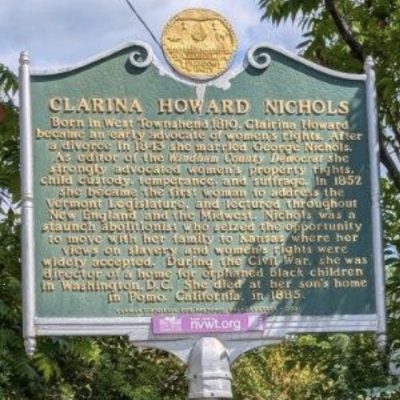
A historical marker in Townshend, Vermont recognizing Clarina Nichols.
She was born Clarina Irene Howard in 1810 in West Townshend, Vermont. The home she grew up in still stands on the village green. She received an elementary education. Her intellect was noticed and nurtured from an early age, however, higher education was not available to her.
She made an unfortunate first marriage where she was quickly schooled in what can happen to a woman when she needs to take care of herself and has no rights to do so. She learned firsthand how few laws there were to protect her.
To support herself, she wrote stories for local newspapers forming a relationship through the mail with the publisher of a newspaper in Brattleboro, Vermont whom she eventually married. This was a good marriage. Her husband treated her with respect. When he fell too ill to run the paper, she took over, establishing a name for herself in the newspaper world. Eventually, she used the paper to speak about women’s rights and began to make even more of a name for herself.
When that felt too small for her, she left the newspaper to travel and lecture on Temperance and women’s rights.
She attended the first women’s rights convention and was invited to speak at the second, making many friends and associates whom she continued to work with for years, including Susan B. Anthony. She was also the first woman to speak before the Vermont legislature in 1852.
 I was delighted to find out that Clarina Nichols is still remembered and honored in Vermont by the Clarina Howard Nichols Center in Morrisville, Vermont founded in 1981. This center offers “a diverse array of services dedicated to achieving our mission of ending domestic and sexual violence, human trafficking, and stalking in Lamoille County, VT.”(https://clarina.org/about/)
This organization captures perfectly the causes that were near and dear to Nichols’ heart.
Onward to Kansas
Even with all that she had achieved in Vermont, that too began to feel too small for her, and Vermont and the Northeast too stifling, so when the U.S. government opened the Kansas Territory to settlers, she moved there.
This was a very difficult time for the Indians who lived there and had previously been promised the land by the U. S. Government. This included the Delawares, Kanzas, Kickapoos, Miamis, Osages, Ottawas, Sacs and Foxes, Shawnees, Wyandottes, and others. They were to be forcibly relocated to Oklahoma.
Non-native Americans were invited to settle in the Kansas Territory and offered land grants. Many northern Abolitionists were worried that Kansas would become a pro-slave state. The only way to stop that was to have abolitionist settlers move there and shape the laws of the state as it formed.
From her travels, Nichols had seen how women in the newer states seemed to have more freedom and rights than in the more settled states. She envisioned Kansas having the potential to pass the first women’s rights and even possibly becoming the first state to gain suffrage for women. In 1854, she went there, first to see if it was viable, and later calling her family to come. Then she began to work on the cause in Kansas.
This was an extremely complicated and devastating time in the Kansas Territory. The fight about the right to enslave other humans was hitting a crescendo, the polarization of Americans was extreme, and the betrayal and continued persecution of Indians was severe. Eickhoff does a good job detailing the ongoing struggles and bloody battles happening in the Kansas Territory at this time.
It’s hard to imagine that Clarina Nichols would leave her established life in Vermont to enter into that madness, but she did. She was so driven by the desire for change, so motivated by the dream of a different way of life, committed to the emancipation of all humans, she sent herself to the prairie to become a farmer with the hope of articulating this new way of life.
Nichols moved there in 1854 and with her family built a cabin and began to farm the land. Living conditions were extremely challenging. Her husband died within the first year. It was a very violent time with pro-slavery Missourians crossing the border to vote in elections.
Two of Nichols’ own sons were involved in a bloody battle alongside revolutionary John Brown against the pro-slavery forces encroaching on the territory. After that experience, they decided it was too stressful for them and headed further west to California.
But Nichols stayed on in Kansas.
“She had, of course, another reason for coming to Kansas, and this was one shared by even fewer people. Nichols believed she would midwife the birth of women’s suffrage there. Her plan was a time-honored one: to circulate a petition throughout Kansas Territory and to deliver as many signatures as she could gather to the men at their convention. This would legitimize her advocacy. If enough respectable citizens of both sexes signed her petition, she would at least be given a hearing. The petition expressed its opposition to “any constitutional monopoly of pre-eminence of rights, based on sex”(145).
She traveled around the territory getting signatures and speaking. She knew she would not be allowed to speak at the convention but Nichols attended, sitting in her seat, knitting. Her unique presence was noted by a NYT correspondent. She garnered so much interest that she was finally allowed to speak after-hours twice. In the end she did not win suffrage for women in the Kansas territory, but:
“Though she failed to achieve her most ambitious goal, she succeeded in getting other rights for women written into the constitution. From the first, Kansas mothers had equal custody considerations with fathers in cases of divorce. Married women had the right to inherit, control and bequeath property in their own names. “Equality in all school matters” meant that the University of Kansas was coeducational from its founding and one of the first public universities to admit women.
Perhaps most significantly in terms of political advances, Kansas women could vote in school district elections. Nichols believed that this precedent would someday pave the way to full suffrage”(152).
Some of these advances were subsequently watered down by judges and politicians, but they were still monumental for their time.
 Diane Eickhoff (1943-2025) was an editor and journalist who was finally was able to fulfill her dream of writing a full-length book when she stumbled upon the story of Clarina Nichols and decided to write her biography. Her obituary reveals that she lost her vision at age 50 and researched and wrote the biography while legally blind. Also,“predominantly through the Kansas Humanities Council, Diane gave more than 200 performances and talks about Nichols to thousands of Kansans. Girls began doing National History Day projects on Nichols, citing Revolutionary Heart or their interviews with the author. Diane continued her talks until cognitive illness forced her to stop in 2020” (https://evanstonroundtable.com/2025/05/30/diane-eickhoff-feminist-historian-dies-at-81)
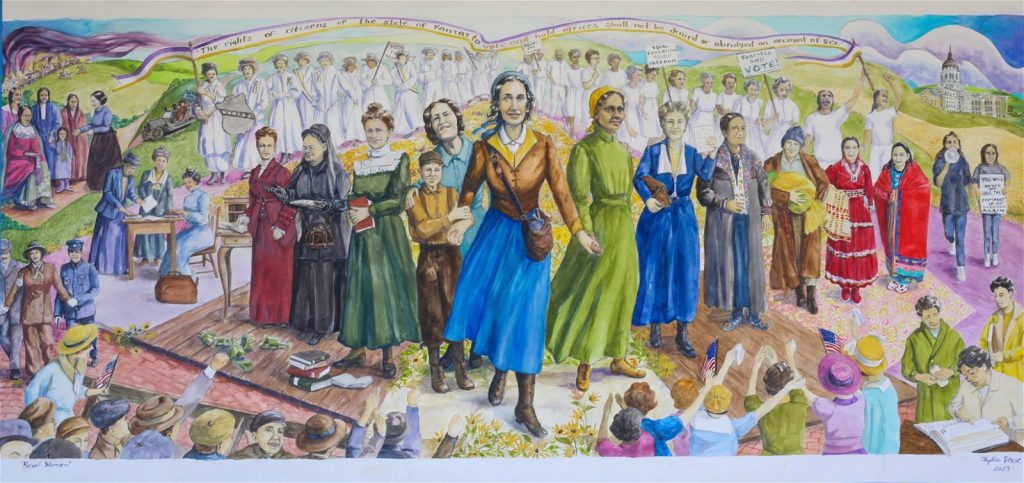
“In 2025, Kansas Gov. Laura Kelly dedicated “Rebel Women,” a 10-by-20-foot mural honoring the long struggle for women’s suffrage in Kansas, at the State Capitol in Topeka. …Rebel Women” depicts Clarina Nichols leading a legion of suffragists in superhero formation” (https://evanstonroundtable.com/2025/05/30/diane-eickhoff-feminist-historian-dies-at-81/)
Phyllis Garibay Coon Pease, the creator of Rebel Women, was moved and inspired by Eickhoff’s book on Nichols and placed Nichols in the center of the mural. “My hope is that this painting will bring to light the untold stories of these women and inspire generations to delve into more of our state’s diverse cultural history.” Also featured are Anna O. Anthony (Leavenworth); Luttie Lyttle (Topeka); Anna C. Wait (Lincoln); Lilla D. Monroe (Wakeeney and Topeka); Annie L. Diggs (Topeka); Laura M. Johns (Salina); Clarina I.H. Nochols (Quindro); Lizzie S. Sheldon (Lawrence); Caroline Langston Hughes-Clark (Lawrence and Topeka); Mamie Dillard (Lawrence); Jane L. Brooks (Wichita); Lucy B. Johnston (Topeka); and Minnie J. Grinstead (Larned and Liberal).(https://www.bethelks.edu/artist-to-present-at-bethel-on-her-statehouse-mural/)
Nichols continued to advocate and fight for women’s rights in other states as well. She eventually moved to Potter Valley, California to join her sons, and lived out the rest of her life there.
Clarina Nichols is a Nasty Woman Writer and Activist.
©Theresa C. Dintino 2025
Works Cited
Eickhoff, Diane. Revolutionary Heart: The Life of Clarina Nichols and the Pioneering Crusade for Women’s Rights. Kansas, Quindaro Press 2006.





 Donate
