

It’s easy to live without thinking about how things were before we came into existence. Perhaps we occasionally think about what life was like before plumbing, automobiles, and anesthesia. Usually, these are passing thoughts or conversations that leave us feeling fortunate to be alive now.
Like most, I entertain these fleeting thoughts. Yet, among these musings, I had never considered what life was like for women before carrying purses was a trend, and by trend, I mean much more than a fashion trend.
Kathleen B. Casey’s book, The Things She Carried: A Cultural History of the Purse in America, is an awe-inspiring work in its detail and candor. Casey, Professor of History and Director of the Women’s Gender and Sexuality Studies Program at Furman University, sheds comprehensive light on an overlooked phenomenon: the advent of the woman’s purse in the United States.
Casey has packed this book as full of interesting essentials as many women pack into their purses daily. When you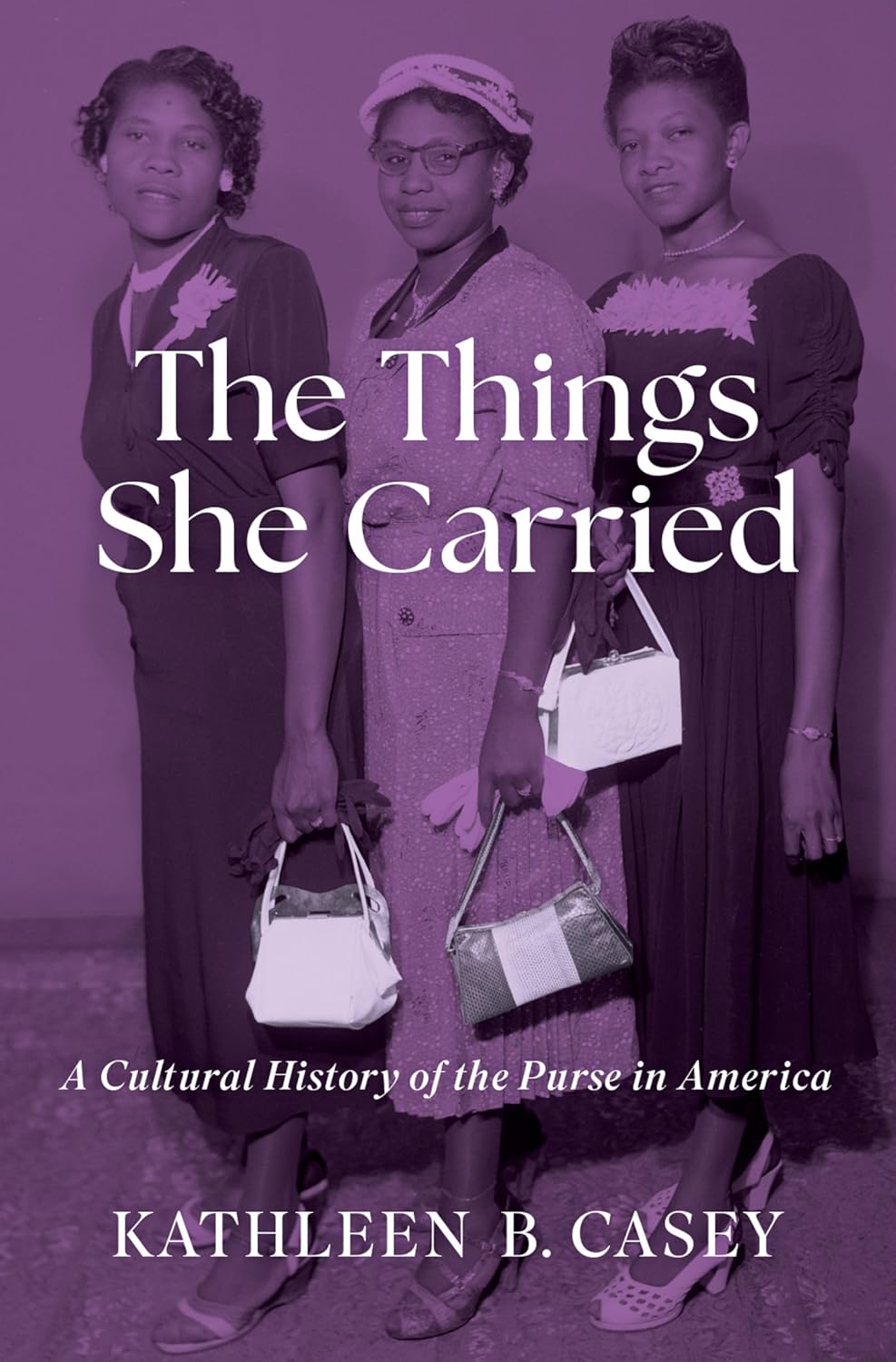 think there can’t be another item in that well-worn handbag, Casey extracts something more.
As she states in the introduction, the book is:
“organized both chronologically and topically, beginning in the mid-nineteenth century and ending with an epilogue that ventures into the twenty-first century, when women and other gender and sexual minorities have arguably experienced some of the most profound changes in American history”(12).
Although Casey covers numerous time periods and events, her focus remains on the quality of people’s lives as it relates to this mobile object.
“It centers on how ordinary women and some men used purses in the pursuit of space, privacy, and power”(12).
Purses and Pockets
“Reticules, miser’s bags, carpetbags, sacks, pocketbooks, handbags, and purses name different objects, though each of these terms refers to a human-made personal container designed for the daily purpose of carrying items outside of the home”(5).
Some of these terms and objects are still in use, while others have been phased out, such as the miser’s bag, for carrying coins, and the carpetbag, which usurped the bulky trunk. Both were designed for men and popular in the 1800s. Men had the money and were more often on the move. They also had the pockets!
“However, men’s pocketbooks and purses during this time almost never featured a large, cavernous space that afforded them significant privacy in public. (The many pockets in their suits and the right to traverse the city alone already provided that.)”(67).
Along with women’s changing roles, purses were expanded from smaller, more ornamental reticules designed for calling cards and a couple coins. This redesign of the purse complemented women’s increased freedom as their lives began to shift from the domestic sphere to more opportunities for working away from home.
“As the size and style of pocketbooks began to change in the late nineteenth century, so, too, did the American labor force. The number of waged working women increased from 18 percent in 1890 to 24 percent in 1920”(63).
If women’s clothing had as many pockets and ones as spacious as men’s, perhaps the purse would not have become such a vital accessory. Casey addresses the long-standing issue of gender inequality and pockets:
“There are multiple theories about why such a large discrepancy existed between men’s and women’s access to pockets. But perhaps there is no simpler explanation than the fact that women have nearly always been given less space than men, even among the most privileged classes”(23).
While women continue to rally for suitable pockets, it’s obvious that the evolution of the purse supported a new degree of liberation for women in the United States, one that included more prospects for earning money.
Sacks Repurposed
Few people in the history of the United States have had less space, privacy, and power than enslaved Black women. Some of the earliest human-made personal containers in this country were created as a clandestine means to care for oneself and others.
“However they acquired them, [enslaved] women repurposed these sacks, fashioning them into private pockets, additional layers of clothing, and emergency bags to be packed in preparation for running away”(19).
It’s said that necessity is the mother of invention, and this compelled enslaved women to make bags out of what they had at their disposal, such as grain sacks. These bags, hidden under their skirts and aprons, created a private space to stash food and other items for their families, as well as mementos to pass along to those precious ones they knew would soon be sold.
Casey details this phenomenon and references another historian and writer, Tiya Miles, who wrote a book on the subject.
“In All That She Carried, historian Tiya Miles examines the remarkable journey of a sack beginning in the hands of an enslaved Black mother named Rose who was living in South Carolina. When Rose learned in 1852 that her 9-year-old daughter Ashley would be sold away, she grabbed a sack made out of cotton and filled it with ‘a tattered dress, three handfuls of pecans, and a braid of her own hair’ to give to her daughter…the sack would provide a pivotal link between four generations of Black women”(25-26).
It’s hard to imagine a more meaningful and lasting use for any sort of bag. Connections of this kind do not come about without a container, one that holds far more than material possessions.
Read our post about Tiya Miles and her book: All That She Carried by Tiya Miles: Recovering the Untold Stories of Black Women in America
Liberation in the Bag
That the purse played such an important role in women’s migration from the domestic sphere to the public is indeed a fascinating occurrence to examine.
“In growing cities, purses challenged existing hierarchies by facilitating women’s transition from the private to the public sphere. In fact, in the early 1900s, American cities were still largely perceived as masculine spaces”(77).
Armed with purses, women could exist and even thrive away from home by bringing what they might need with them.
“Working women themselves turned purses into spaces that were full of possibility in modern cities. Purses provided limited square footage but a much-needed place to store their objects and aspirations. Thus, women nearly always took purses with them when they left for home. And in the early 1900s, women stayed away from home for far longer than their mothers and grandmothers had”(80).
What, one might ask, do the women need while away from home for hours at a time? This clearly varies from woman to woman, and some items are more necessary than preferential. This shift in the workforce and in women’s lifestyles spurred a whole new industry: pocket-sized and disposable items.
“Personal products specifically marketed to fit inside of a woman’s purse forged a close and seemingly organic relationship between women’s bodies and their bags…women could dip into their purses to freshen their makeup, reapply perfume, reach for a Midol tablet to dull their period pain, and even grab a new disposable sanitary napkin…And by the 1930s, purses had become proxies for women’s bodies”(83).
Before disposable sanitary products, it was difficult and inconvenient for menstruating women be away from home for too long. Also, this was before the shroud of shame around menstruation was partially lifted.

Ad for Tampax tampons, Woman’s Home Companion, March 1937, p. 124.
The invention of applicator tampons, more easily stored in a purse’s private compartment, allowed women even more freedom and confidence to be away from home for longer stretches. (Although invented in the 1930s with an uptick in popularity after WWII, the applicator tampon did not become mainstream until the 1960-70s.)
“Both the purse and the tampons were explicitly framed as complementary liberatory tools”(98).
Yet, it seems these “liberatory tools” came with an unfair price tag, one that today we call the “Pink Tax,” referring to the higher cost of women’s hygiene products.
“In the 1920s, 1930s, and 1940s, purses were a literal “mixed bag” for women. They held feminine and personal hygiene products that offered girls and women new levels of mobility and novel ways to manage their bodies…However, these changes also increased the standards by which women were supposed to discipline the supposedly shameful parts of their bodies and spend their meager wages in doing so”(107).
An Aide to Activism
Shifting from women’s foray onto city streets and into the labor market to their recurrent fight for rights, the women’s purse continued to make and leave its mark.
Author Casey describes undercover human rights journalist Nellie Bly:
“In the late 1880s, Nellie Bly was the literal picture of the plucky, brave New Woman in modern America…In addition to her leather satchel, Bly wore a ‘chamois-skin bag, which I tied around my neck’…Necklace bags helped offset the lack of integrated pockets in women’s clothing; because they rested on the chest and had to be lifted over the head, they were harder to steal than a purse hanging from one’s hand”(37).
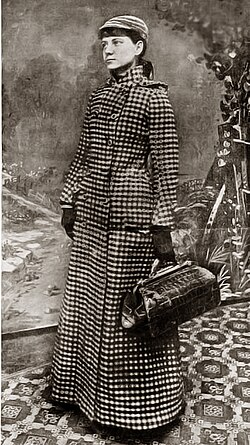
A publicity photograph taken by the New York World newspaper to promote Bly’s around-the-world voyage.
Designers and marketers of women’s purses promoted their safety features and how their handbags could provide a sense of security, enabling women to engage in more activities in the public sphere. Attention was paid to designing purses less likely to be snatched, dropped, or left behind.
“During these transitional decades, women… increasingly pictured themselves as active participants in public life. They wrapped up a petite portable version of the domestic sphere in their purses and bags, and stepped out, heading to work outside their immediate neighborhoods”(39).
In addition to working away from home, women increased their engagement in public life through activism, such as campaigns for women’s suffrage and the right to vote.
“Early suffragists used purses in their activism and, in later decades, would make more explicit use of bags in their campaign for the vote. In 1853, one of the most famous suffragists, Susan B. Anthony, wrote in her diary that “every woman must have a purse of her own”… Anthony’s happened to be a “dark red alligator bag”(45).
Fast forward to the mid-20th century and the fight for Civil Rights, where the purse became more than a container for carrying money, personal items, and pamphlets. If needed, a purse could be brandished or held close to the body, both for protection. It could also be used to conceal a weapon.
“Yet, Black women carrying purses did more than just follow the rules and regulations of appearance. Since the police and judicial system refused to protect Black women’s and children’s bodies, Black women used their purses to protect themselves.
“In such situations, purses and bags functioned as resourceful toolkits containing money, weapons, a change of clothes, or simply a bodily shield to keep white men from getting too close”(112-117).
Handbags were also conspicuous in the fight for LGBTQ+ rights, as in the 1966 Compton’s Cafeteria Riot:
“On the night of the Compton’s uprising, a reported sixty drag queens were present, and many of them used their heavy purses to hit police officers in the face and below the belt”(137).
Casey points out that the purse was, by and large, feminized during its earlier evolution, dictating who was allowed to carry one versus who made a statement and took a risk when doing so.
“Purses could simultaneously protect some while rendering others extremely vulnerable. Taken together, these experiences reveal the power of purses to reveal how queer people conceptualized, carried, and relied on these sartorial symbols to negotiate and communicate their sexuality”(154).
An Ongoing Evolution
Purses continually evolve, with new styles, improved safety features, and creative compartments, along with a shifting identity in American culture. For example, the messenger bag launched for men in the 1990s proved popular, along with the emergence of the “murse” (man purse), which has gained traction over the past decade.
Perhaps the purse pendulum will land in a more gender-expansive place, as in some other countries. After all, it is a handy item, and men carrying their own will lighten women’s loads since we’re often asked to carry items for them!
Yet it’s doubtful that any future shifts in the evolution of the purse can match the impact it has had on the lives of women in the United States over the past two centuries.
“Ultimately, they [purses] have provided adaptable means and materials for women’s activism, expanding their agency, providing privacy, and helping them cross boundaries at so many unexpected corners”(158).
Kathleen B. Casey is a Nasty Woman Writer.
© Maria Dintino 2026
Works Cited
Casey, Kathleen B. The Things She Carried: A Cultural History of the Purse in America. Oxford University Press, 2025.





 Donate
