

Though some complained about the growing number of “cults” in California in the 1930s, for Nasty Woman Artist Agnes Pelton it was liberation.
In 1928, Agnes Pelton went to study at the Theosophy Society in Pasadena, CA, where she studied Theosophy, Hinduism, meditation and transcendence. She had long been a student of alternative health and spirituality as well as an artist, but until she traveled from Pasadena to Cathedral City, she had not found her true home.
At the time, Cathedral City was not developed. The open desert sky and landscape with the view of the San Jacinto and Santa Rosa mountains matched what Pelton had been experiencing in her spiritual visions. Also, there was a community of like-minded women settling there, forming an artist colony of women, most of whom were queer. At age 50, Pelton found her place. She remained there the rest of her life, painting some of the most powerful works of what she called Abstractions, while deepening her relationship with the land and spiritual dimensions she had come to know through years of study and devotion.
Cathedral City, a desert town 120 miles east of Los Angeles, southeast of Palm Springs in the Coachella Valley, has been home to the Cahuilla people for thousands of years. Pelton was inspired and informed by the beliefs of the Cahuilla and their relationship to place.
In her 1932 painting, Messengers, with its palm fronds atop a mystical container or being that hovers over the mountains, some see a nod to the Cahuilla who used palm fronds to cover their homes. But it is more than that. For the Cahuilla, the fan palms (Mául) native to their canyons, are a sacred gift. The desert fan palm is North America’s only native palm tree. One of the Cahuilla core myths tells the story of an ancestor who turned himself into a fan palm to provide shade, shelter and resources for his people.
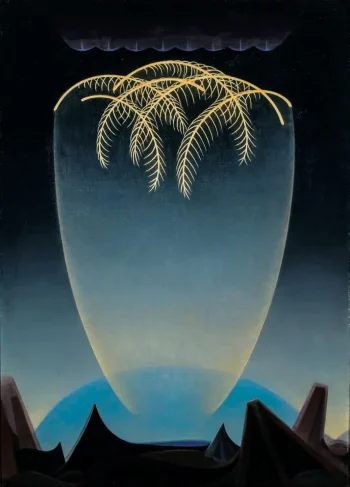
Agnes Pelton, Messengers, 1932. Phoenix Art Musem.
“When Pelton arrived in 1932,” Ed Ainsworth wrote in Palm Springs Villager,
“She visioned the great stars in the clear air and the healing sunshine pouring its beneficent rays upon a world of serried dunes.”
. . . Here, the artist painted in solitude under the sky, returning to the studio to “work over” her pictures “many times to get the effect I want,” she told the Villager. The desert’s distinctive glow had an immediate and lasting effect on Pelton and her art. “The vibration of this light, the spaciousness of these skies enthralled me. I knew there was a spirit in nature as in everything else, but here in the desert, it was an especially bright spirit.”
She was known to take in the night sky from her garden, cataloging her visions in a vocabulary of curvilinear and biomorphic forms, brilliant orbs, and delicate veils.
“The aim of these abstract paintings over many years,” she said, “has been to give life and vitality to the visual images [that] have appeared to me from time to time in receptive moments, as symbols of fleeting but beautiful experiences.”https://www.palmspringslife.com/arts-culture/desert-dreamers-10-the-artists/
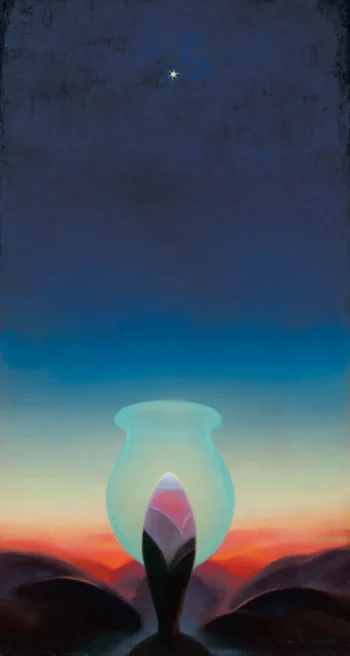
Agnes Pelton, Star Gazer, 1929. Collection of Susan And Whitney Ganz.
Pelton wanted her art to reflect what she called “Divine Reality,” a term taken from Theosophy.
“In her home in Cathedral City she had a meditation room where she “practiced rituals involving incense, trance states, and prayer, which she used to further hone her Abstractions. Painting was a devotional practice for Pelton, a means of articulating her spiritual beliefs on modern art terms”(Doss, DT 39)
It was a time of great opening in spiritual beliefs. This opening was created by the suffragists, the spiritualists and the abolitionists of the mid-19th century. Women were empowered in this opening and many became spiritual leaders at this time. Pelton studied many disciplines and adhered to none. She made her own way, combining all she had learned with her experienced reality. Her art introduces us to what is uniquely hers.
Read Nasty Women Writers posts:
How the Nineteenth-Century Spiritualist Movement Gave Voice to American Women
Nasty Woman Artist Hilma af Klint: How the World Works
Previous to Cathedral City, Pelton lived in a windmill on Long Island, retreating there from her home in Brooklyn, New York after her mother’s death. There she painted her first Abstraction at age 45. Although there isn’t a lot out there about Pelton’s personal life, one can learn a lot from the people one hangs out with. Pelton’s friends are colorful, famous, feminists, artists, queer, and very much into living in a new and different way. Many of them are called “New Women.” The New Woman of that era, the late 19th and early 20th centuries, are defined as independent women seeking radical change. These women, Emma Hopkins, Mabel Dodge, Alice Brisbane Thursby, and Alice Boughton, were dynamic women forging ahead and creating new pathways. These were Pelton’s good friends even before she moved West. It is important to put Pelton in this category as well. She seems to have been more internal and perhaps quieter, but her voice speaks loudly through her art. I have learned a lot in researching Agnes Pelton. There are so many nasty women artists among her friends that I have not heard of until now. She was embedded in a web of powerful women, artists, and spiritual leaders.

Agnes Pelton, The Voice. 1930. Also titled, Silence. University of New Mexico Art Museum.
In the 1910s, Pelton was good friends with the photographer Alice Boughton, a “New Woman” who went on to become one of the most sought after photographers for the wealthy in New York. Boughton took many portraits of Pelton at this time.

Alice Boughton, 1883. by Sanford Bennett Duryea
Both Boughton and Pelton were contemporaries of Georgia O’Keeffe. They studied with many of the same teachers. Pelton studied at Pratt, where O’Keeffe attended as well. Both Boughton and O’Keeffe had the influential Alfred Steiglitz to promote their work which may account for them being more widely known than Pelton.
Pelton grew up in Brooklyn, New York, the daughter of a single mother who was interested in alternative healing and ran a music school. Her family had been forced into the identity of outsider by a scandal in Pelton’s grandparents’ generation that was a public fiasco. Her mother’s mother, Elizabeth Tilton, had an affair with the prominent Pastor Henry Ward Beecher. Pelton’s grandfather sued the preacher when he discovered this. It was a six-month trial. The press had a field day with the sordid details. The Tilton family was shunned and lost their social standing. Pelton’s mother, Florence, 12 at the time, was eventually sent away to Germany to study music. That is why Agnes Pelton was born in Stuttgart. Florence married William Pelton, an American expat, who died when Agnes was nine. Back in Brooklyn, Pelton’s mother opened a music school, took in boarders, and became involved in the alternative health and spirituality movements.
In her younger years, Pelton studied and received mental healings with Emma Curtis Hopkins in Chicago.
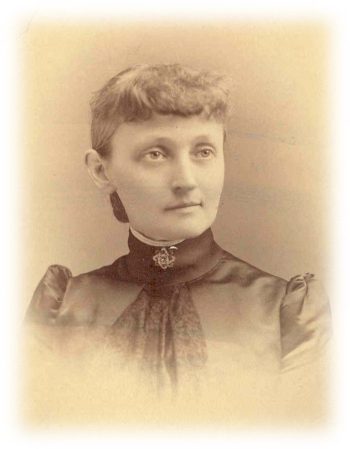
Emma Curtis Hopkins
Emma Curtis Hopkins (1845-1925) started her own mystical school which involved “mental thought” practices for healing which Pelton attended. Hopkins preached that the Holy Spirit was a woman. Pelton formed a relationship with this deity, and prayed to her for the rest of her life. In 1933, she painted her image in Mother of Silence and continued to interact with the painting as a shrine.
Emma Curtis Hopkins was an extremely influential teacher and leader of the New Thought movement. Many of her classes have been compiled into books which are still available today. They include mental treatments for healing self and others. She is also called a mystic and influenced many people who came after her.

Agnes Pelton, Mother of Silence. 1933. Private Collection
Pelton began studying Agni yoga in 1930 at the recommendation of her friend Dan Rudhyar (1895-1985), a painter, composer and astrologer. He is now considered the founder of humanistic astrology which takes a psychological approach to astrology using it as a tool for self-understanding and personal growth.
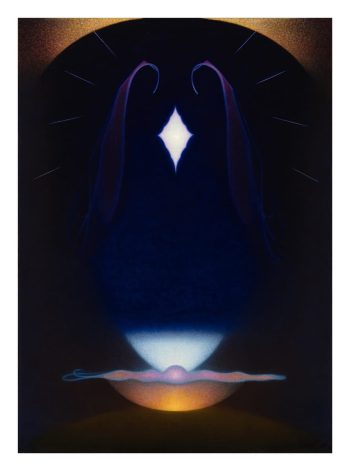
Agnes Pelton, Alchemy. 1937-1939. The Buck Collection at the UCI Institute and Museum for California Art.
By the time she moved to Cathedral City, Pelton was already an established artist. Years previous to her move, Mabel Dodge, (a lifelong friend whom she had met in Emma Curtis Hopkins’ school), invited her to spend a few months in her renowned artist colony in Taos, New Mexico. This is where Pelton first fell in love with the open sky of the desert landscape. Dodge and her 4th husband, Pueblo Tony Lujan, visited Pelton in her Cathedral City home once she settled there and engaged with the company of women she kept.

Mabel Dodge
“Mabel Dodge was known internationally as the “New Woman,” a sexually liberated radical whose wealth enabled her to be a patron of artists, writers, philosophers, and reformers who defined the avant-garde” (https://burchfieldpenney.org/art-and-artists/people/profile:mabel-dodge-luhan/).
“Pelton’s social, cultural and religious orientation as a modern artist was framed by female agency and independence: from the model of her own self-employed mother, who rejected marriage and sought physical healing through alternative health practices, to the encouragement of patrons such as Dodge and Alice Brisbane Thursby. Both were “New Women” whose expectations of feminist autonomy extended to understandings of art and of faith, such as New Thought’s female-centric spirituality”(Doss, DT 36).
Pelton’s work captured light and transcendent images in a way unique and expressive of her expansive visions.
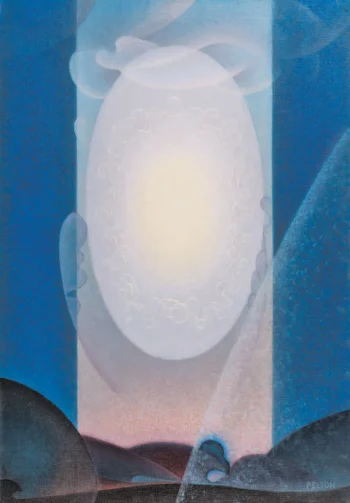
Agnes Pelton, Light Center, 1960-61. Euphrat Musem of Art.
“Pelton labored long on her transcendental canvases, creating in her best paintings an unmatched depth of resonant, glowing color through delicate stippling or careful layers of thin glazes. Completing an abstraction took weeks or months of meticulous labor”(Doss, DT 49).

Agnes Pelton’s portrait of Christina Lillian. californiadesertart.com
In Cathedral City, Pelton was good friends with Christina Lillian who owned Sven-Ska artist colony. Christina Lillian was a fashion designer of Swedish descent. She had grown up in a Swedish community in Kansas and learned dressmaking. Always a feminist, she declared at an early age that she would never marry. She moved to Hollywood where her successful career allowed her to retire and open Sven-Ska.
“Like Mabel Dodge in Santa Fe, Christina was seeking “a new world plan.” The ingredients included communal living, immersion in nature, study of metaphysics and spiritual pursuits. A cornerstone of this new world was art. While Christina was an artist herself (she made constructions from cast-off tin and called them Taos Tintypes), she poured most of her energy encouraging and housing her fellow artists”(https://www.californiadesertart.com/the-lost-colony-of-sven-ska-christina-lillian-and-the-cathedral-city-artists/).
Harriet Day, artist and manager of the Desert Inn Art Gallery and artist and horsewoman Matille Prigge Seaman, known as “Billie” who dressed as a man, were also among Pelton’s friends in Cathedral City.
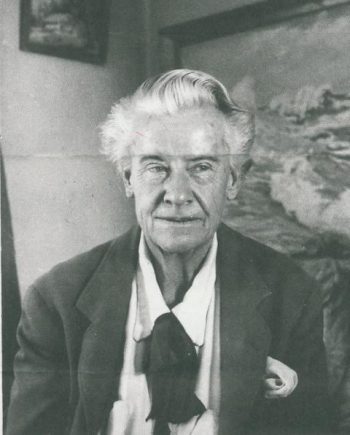
Matille Prigge Seaman, “Billie”
Pelton and friends founded the Palm Springs Art Museum, the Desert Art Center and staged exhibits in Pelton’s studio.
“The Sven-Ska women were fully immersed in small town life-decorating tables for women’s club luncheons, giving neighbors rides to the market-at the same time they were quietly probing philosophy, the occult, mysticism, theosophy and how it all related to art”(https://www.californiadesertart.com/the-lost-colony-of-sven-ska-christina-lillian-and-the-cathedral-city-artists/)
As with any great artist, one does not need to know Pelton’s beliefs to be moved by her art. Her art stands for itself with no interpretation. A person is moved to have their own transcendent experience evoked by the paintings and interpret them as they wish.

Agnes Pelton, The Fountains. 1926. Museum of Modern Art.
Pelton died in 1961 and her work fell into obscurity.
It is a group of women who stumbled upon Pelton’s work in 1979 and brought it forward to the now. Read about that in Nasty Women Writers post: Agnes Pelton, Jan Rindfleisch and the Importance of Archives of Women Artists
Agnes Pelton is a Nasty Woman Artist.
© Theresa C. Dintino 2026
Works Cited
Biller, Steven. Desert Dreamers 10: The Artists. Palm Springs Life. https://www.palmspringslife.com/arts-culture/desert-dreamers-10-the-artists/
Doss, Zakian, et al. Agnes Pelton: Desert Transcendentalist. Phoenix Art Museum. Hirmer, 2019.
Japenga, Ann. The Lost Colony of Sven-Ska: Christina Lillian and the Cathedral City Artists. californiadesertart.com https://www.californiadesertart.com/the-lost-colony-of-sven-ska-christina-lillian-and-the-cathedral-city-artists/




 Donate
