

In researching Minoan Crete I was delighted to find that one of the archaeological digs that yielded a treasure trove of finds and information, in fact a whole Bronze Age town, was uncovered in 1901 by a feisty American woman archaeologist named Harriet Boyd Hawes.
“Her tiny frame of just over five feet packed the power of a giant, and she exerted a decisive and active will always bent on achieving the things she believed in. Her life’s work included Greek archaeology—and lots of it—as well as nursing for the Red Cross in the direst of war conditions, teaching, lecturing, and being a wife and a mother”(Adams 118).
Boyd Hawes decided to become an archaeologist when women weren’t even allowed to run their own digs. But she did. She was drawn to Crete because of other digs uncovering the Bronze Age Minoan culture there. She went on to unearth the Minoan town of Gournia, leading the dig, and overseeing more than one hundred workers at a time.
In the Chapter titled “Just like a Volcano” in Ladies of the Field: Early Women Archaeologists and Their Search for Adventure, Amanda Adams writes of Boyd Hawes:
“In time Boyd Hawes revolutionized understandings of local archaeology and chronology on Crete, single-handedly directed excavations for multiple seasons with crews of one hundred men, and made legendary contributions to the emerging science—then more precise and respected than ever—of archaeology”(119).
 As an undergraduate at Smith College in Northampton, Massachusetts, Boyd Hawes studied classics with an emphasis on Greece. While considering Europe for graduate school, she was inspired to go study in the places that interested her. She ended up in Athens at the American School of Classical Studies.
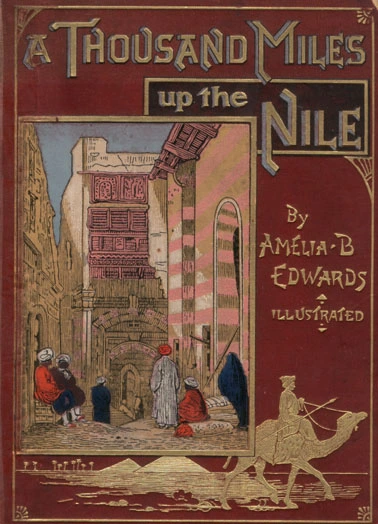
Adams points out that while at Smith, Boyd Hawes was inspired toward archaeology when she heard Amelia Edwards’s lecture A Thousand Miles Up the Nile, based on her own adventurous journey up the Nile and the book she wrote and illustrated about it. After that Boyd Hawes didn’t want to study only from books, she wanted to pursue field investigations.
“There was only one snag in Boyd Hawes’s plans: the director of the American School in Athens, through power or influence, kept the women from excavating. Some male professors felt that women shouldn’t even be allowed to join class field trips to the the country’s notable archaeology sites. The physical demands of wielding a pickaxe, even a hand trowel, were seen as not just unladylike but also as strenuously impossible. Ladies just didn’t belong in the dirt”(Adams 122).
The web of women writers
 Nasty Women Writers is always interested in discovering what we call the web of women writers. We love to discover which woman inspired another woman or which nasty women were friends and supported each other.
See Nasty Women Writers piece: Invisible Connections: The Hidden Web of Women Writers
This web is vast, intricate and alive, and Boyd Hawes made good use of it and contributed to it. She went on to inspire many other women, including them in her work and mentoring them in archaeology. For anyone this kind of support, modeling and mentoring is invaluable but even more so for women who often have to search hard for women who have already accomplished the things they dream of doing.
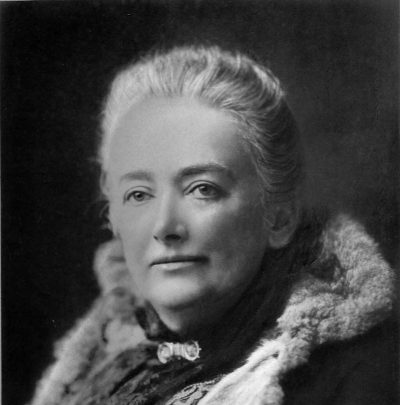
Amelia Edwards
Amelia Edwards (1831-1892), born in London, was a popular novelist and writer who loved to travel and explore. A trip up the Nile led her into an amateur archaeological dig and turned her interests completely to archaeology. Edwards formed the Egypt Exploration Fund and raised money to fund archaeological excursions to Egypt. She wrote and lectured about the importance of archaeology. Her work led to what we call Egyptology today and broke open the field of archaeology to women. No doubt, in those lectures she not only excited interest but encouraged women to get involved.
Onward to Crete
In 1900, Boyd Hawes decided to leave Athens to get away from the prohibitive atmosphere there and try Crete where there was more opportunity for digging. She secured a grant from the Archeological Institute of America. She wished to focus on the Minoan layer, the time period from 3000-1450 BCE.
“This sustained success in the Minoan field increased my desire to find a site belonging to the days of Cretan supremacy, prior to the introduction of iron, antedating even the greatness of Mycenae”(Gournia 19).
She had a permit to dig in only one area so she had to choose carefully. Her first expedition was productive. She hired the crew that would become her senior crew and stay with her for the rest of her time in Crete over multiple seasons of excavations. On this first dig she had brought along a Miss Patten from Boston who was a botanist. I have not been able to find out much about Miss Patten but I include her to illustrate how consistently Boyd Hawes deliberately included women in her work.
That first dig exposed a layer from the Iron Age.
“On a peak called the Citadel above Kavousi, we uncovered thirteen rooms a chieftain’s house and found the oldest circular game-board yet discovered in Greek lands”(Gournia 19).
Traveling back to America and lecturing on her work, she gained funding to continue.
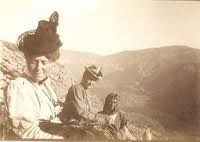
Blanche Wheeler Williams
For her next round in 1901 she brought Blanche E. Wheeler (1870-1936) back with her, who, after her marriage, became known as Blanche Wheeler Williams.
Blanche Wheeler Williams went to Smith College with Boyd Hawes. She was also an archaeologist and worked with Boyd Hawes on the Gournia dig in 1901. She also contributed to the book on Gournia which Boyd Hawes published in 1908, detailing the three years of digs.
Uncovering Gournia
Upon their return in 1901, Boyd Hawes and Wheeler traveled around on donkeys looking for their next place to excavate. They were given a lead by a local antiquarian from the town of Vasiliki. Upon inspecting the site, they knew this was their next dig as it revealed a Bronze Age layer of occupation: A Minoan Village.
Boyd Hawes wrote:
“Within three days we had opened houses, were following paved roads, and had in our possession enough vases and sherds bearing octopus, ivy-leaf, double-axe and other unmistakably Minoan designs, as well as bronze tools, seal impressions, stone vase, etc., to make it certain that we had found what we were seeking”(Gournia 19).
A plate from the book Gournia, showing finds from the dig.
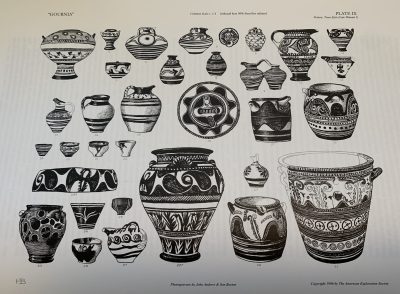
This digging revealed the site of Gournia. Wheeler and Boyd Hawes lived in a rat-infested apartment, uncovering this village and preserving its remains.
“Here was a full settlement where the daily lives of people who farmed and fished, hammered bronze, carved stone, and looked out to the sea for trade boats and news, could be uncovered and understood. It was a new and critical link in the chronology of Mediterranean archaeology”(Adams 128).
The seaside village of Gournia exposed the daily lives of Minoan Crete’s occupants, not only the palaces and treasures. This was the beginning of this more humble interest of archaeology—everyday life.
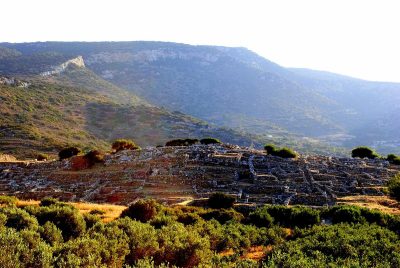
The excavated town of Gournia, Crete
Finding the Goddess In Gournia
Wikipedia reports that:
“Williams wrote the appendix of the monograph on Gournia. Her section focuses on the importance of a nature goddess in Minoan religion. The role of female deities in Minoan Crete had been a focal point of interest in the site, and Williams wrote about a terracotta female idol found in a shrine near the top of the hill at Gournia. Williams proposed that the nature goddess and Minoan women enjoyed elevated social importance in the culture, and buttressed her claims with reference to the classicist Jane Ellen Harrison. Williams’s contributions also covered stone vases and seal stones. The 1908 book was praised by the archaeology community”(https://en.wikipedia.org/wiki/Blanche_Wheeler_Williams).
Boyd Hawes also acknowledged the preeminence of the Goddess and high position held by women in the culture she was uncovering.

Gournia, Vasiliki and other Prehistoric Sites on the Isthmus of Hierapetra
In the book Gournia, Vasiliki and other Prehistoric Sites on the Isthmus of Hierapetra, Crete she writes of the discovery of the shrine found up on a hill above the town, where in the NE corner of the room was an earthen table with three legs with three terra cotta vases around it, a broken one on the table and a female figure entwined with snakes: A shrine of the Snake Goddess.
“The well-worn, special approach to the enclosure and the unique character of its contents, paralleled, up to that time, only in some respects by finds from a cemetery near Prinia, attested the singular importance of this discovery, and further study of details, such as the “horns of consecration,” the snakes and the doves, and the attitude of the figure led to the conclusion that these objects had a religious significance, and that at Gournia had been discovered the first example of a domestic shrine sacred to the goddess, who from first to last, appears to be the chief divinity of the Minoans”(47).

Snake Goddess found at Gournia
“Blanche was the artist in charge of drawing the finds, as well as making detailed maps and plans of the area. . . During this first season of excavation they found hundreds of artifacts, and Blanche was put in charge of drawing the most important ones. These “major finds” were vases, since not only was the decoration beautiful, but it could be correlated to the finds at other Bronze Age sites and therefore help to establish a relative chronology of the site”(https://www.brown.edu/Research/Breaking_Ground/bios/Williams_Blanche%20Wheeler.pdf).
Blanche Wheeler Williams went on to teach at a preparatory school for girls and influenced many young women to join the field of archaeology.
A powerhouse archaeologist
Boyd Hawes was the first woman to run a dig by herself. She also published her findings in a methodical and scientific manner and was invited to speak at the Archaeological Institute of America. Adams points out that these were all very important firsts. She was considered a legitimate archaeologist and respected in the field.
Adelene Moffat accompanied Boyd Hawes in 1903. I have not been able to find any information about Adelene except the donation of two items found in Crete to the Museum of Fine arts in Boston (one pictured below) in honor of Boyd Hawes.
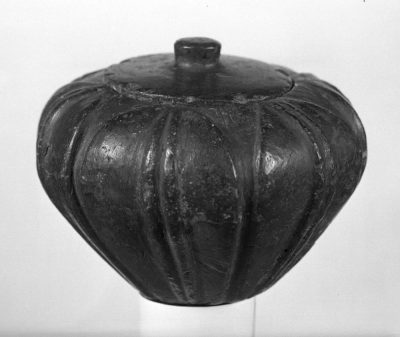
Blossom bowl, Early Aegean, Minoan Bronze Age, bequeathed by Adelene Moffat to MFA in memory of Mrs. Harriet Boyd
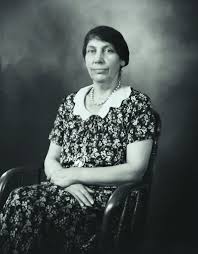
Edith Hall Dohan
Edith Hall joined the dig 1904. Edith Hall (1877-1943), who later became Edith Hall Dohan, also attended Smith College and then received a Ph.D. in archaeology from Bryn Mawr. She apprenticed under Boyd Hawes and after Boyd Hawes left, continued on, running her own dig, becoming the second woman to do so on Crete. She also authored and published many books on the art and culture of Minoan Crete.
After the 1904 season, Boyd Hawes married a man she met in Crete. She ceased engaging in field work at age 35 to have a family. Though she continued to write up her research and engage in other cultural and political activities, she missed the field. She hoped women of the future would figure out how to do both. We owe her a debt of gratitude.
Harriet Boyd Hawes is a Nasty Woman of STEM.
© Theresa C. Dintino 2025
Works Cited
Adams, Amanda. Ladies of the Field: Early Women Archaeologists and Their Search for Adventure. Vancouver, Greystone Books. 2010
Hawes, Harriet Boyd et al. Gournia, Vasiliki and other Prehistoric Sites on the Isthmus of Hierapetra, Crete. Philadelphia. American Exploration Society. 1908.




 Donate
