
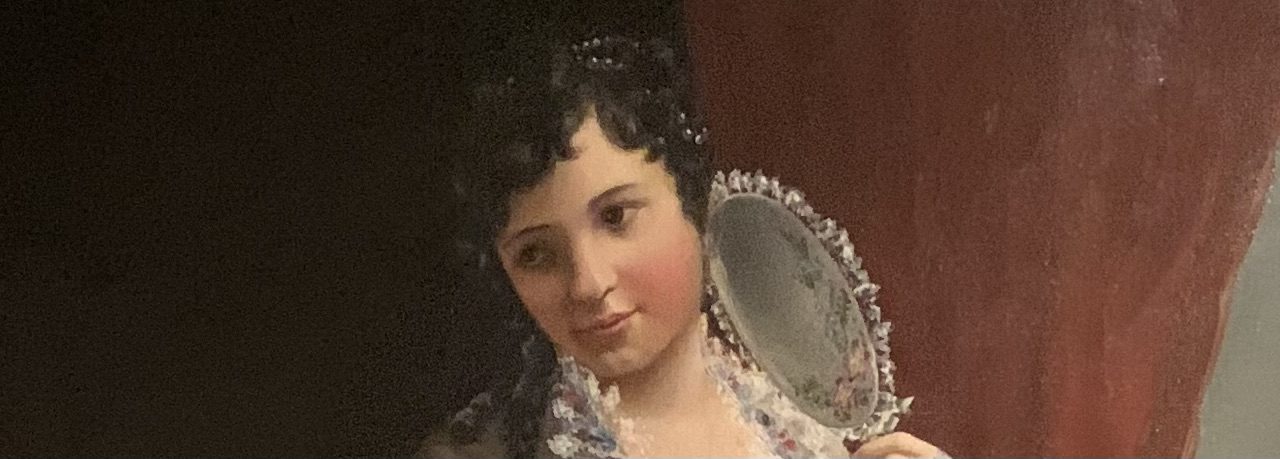
Grace Carpenter Hudson (1865-1937) was an American woman artist who excelled and became very popular in the field of oil paintings at at a time where women were generally unacknowledged in that discipline. Daughter of abolitionist parents, her father fighting in one battle with famed John Brown, they moved from Kansas to Potter Valley, California in covered wagon and were soon made aware of the local indigenous population there: people who have come to be called the Pomo Indians.
Grace’s parents were very concerned with the plight and condition of the Pomoans and interested in their culture. They made friends with many of them and continued these relations when they relocated to Ukiah, California, also recognizing the artistry and value of the baskets they crafted and collecting them.
Read Nasty Women Writers posts on Pomoan Basket Weaver Elsie Allen and Pomoan Dreamer Mabel Mckay:
Elsie Allen (1899-1990): What it Takes to Save a Lineage
Mabel McKay (1907-1993): “Dreamer” and Master Basket Weaver of the Northern California Pomo Indians

Grace Hudson
Grace grew up in Ukiah, eventually attending the California School of Design in San Francisco. Right away, she was acknowledged for her natural talent. Her father ran a photography studio. She learned the craft of setting the scene and capturing an image from him. Grace was an accomplished photographer as well and often took pictures which inspired her paintings.
Because her Pomoan friends were in and out of her home and often on her parents’ land, she began to ask them to sit for her. One of her paintings of a Pomo baby in its carrying basket catapulted her into popularity. She decided the Pomo people were her subject. This turned into a lifelong endeavor, emerging partly from the desire to capture and preserve their lifestyle, arts and rituals—their culture—which she feared would soon disappear and a genuine admiration for her friends and their ways.
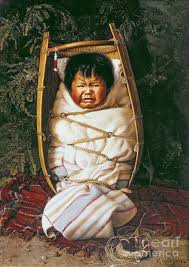
Little Mendocino by Grace Hudson 1892
“While many Western artists painted cowboys, wagon trains, and gold miners, Grace Hudson portrayed the everyday life of the Pomo Indian people from a woman’s perspective. It was said that Pomo Indians love three things above all else: their children, their baskets, and their dogs. Grace Hudson’s most memorable canvases are a testimonial to that love”(56).
Thankfully the Pomo people did not disappear. Grace Hudson, however did preserve a moment in time for them and their people. In a recent visit to the Grace Hudson Museum and Sun House in Ukiah, the docent informed me that many Pomoans come looking for images of the ancestors that Grace painted. There is also a collection of baskets and other items archived there that they can access to learn more about their forebears whom Grace knew, wrote about and painted.
In the forward of the book, Grace Hudson: Artist of the Pomo Indians, Sherrie Smith-Ferri, PhD writes:
“Growing up as a member of a Dry Creek Pomo family that included many artists, I was only a young child when I first learned of Grace Hudson’s work. If there was a chance to see Hudson’s paintings, we went.
Part of the reason we went was pride. At that time, unlike today, being of California-Indian descent was not readily accepted or understood by the community at large. To have a gifted artist use her talent to portray my people was a source of honor. In addition, Hudson primarily got the ethnographic details right—the distinctive textures of the myriad of weaving techniques used to make Pomo Baskets, the undulations of a flicker quill headband, the smooth polish and weight of a strand of clamshell disc beads, the string of surf fish drying over the fire in a home’s smoky interior. . . . It was not until I grew older that I consciously realized what I had known as a young girl—Grace Hudson was painting real people, individuals she knew, not nameless, generalized “Indians”(7).
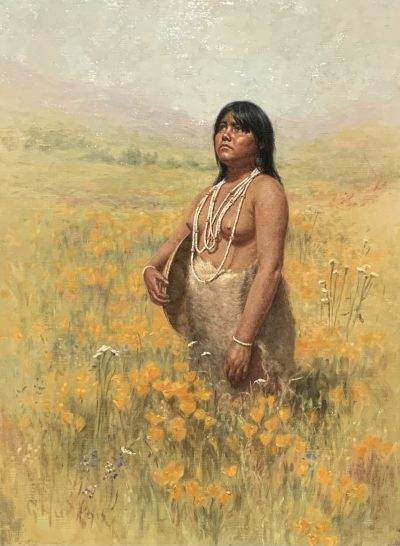
Yesterday by Grace Hudson, 1899. Photo by author.
Clarina Nichols: woman’s rights advocate and grandmother of Grace Hudson
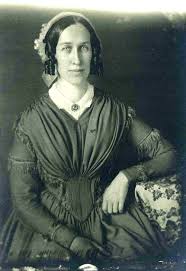
Clarina Nichols
Grace Hudson’s paternal grandmother, Clarina Nichols (1810-1885), was a journalist, lobbyist and crusader for women’s rights. She worked her whole life for temperance, abolition, women’s right to own property, women’s right to her own children, and women’s suffrage. She was a very well respected newspaper woman, and sought after lecturer. She worked alongside all the big names of the women’s suffrage movement.
Read Nasty Women Writers post on Clarina Nichols: Clarina Nichols: Tireless Fighter for Mothers and Women’s Rights
It is clear that Grace Hudson was influenced by her powerful grandmother who also moved to Potter Valley from Kansas when Grace was young. Grace was strong willed, independent and expected to have a career and earn a living.
In the tour of the Sun House at the Grace Hudson Museum in Ukiah, I was shown two tea cups from a set that Clarina Nichols bequeathed to Grace when she died and which Susan B. Anthony subsequently drank from when she came lobbying in Ukiah and stayed with Grace’s family. Clarina Nichols was already dead at this time but Anthony was a long time friend of the Nichols family, so the relationship continued.
Grace Hudson’s body of work
Grace Hudson painted more than 650 portraits of her Pomoan friends. On a long stay in Hawaii, she sought out and painted the indigenous people there. She was also commissioned to paint the Pawnee People in Oklahoma.
Following are some of my favorites from my most recent visit to the Museum with accompanying paragraphs written about them by the artist herself or the Grace Hudson Museum in Ukiah

Grace Hudson, The Seed Conjurer, 1896
“In this portrait, Grace Hudson depicts a portion of a traditional Pomo ceremony performed to ensure an abundant harvest. The “conjurer” wears a number of important items of regalia: an eagle feather dance skirt, a flicker quill headband, several long slender dance plumes, and a feathered topknot. The pieces reproduced in the painting came from the Hudsons’ extensive collection of Pomo artifacts, as did the flute that is being played.
The model for this piece, Tom Mitchell, was a consultant for John Hudson’s ethnographic studies, and he shared a wealth of linguistic and cultural information with Hudson.
He is notable as one of the few Pomo Indian men that Grace Hudson portrayed in his youth. The scarcity of such images might be due to the fact that younger men were busy working for their living on neighboring ranches. Perhaps, too, Grace found portraits of young men less popular, and thus less commercially viable, than portraits of young children or distinguished elders. In any case, the fact that Tom Mitchell agreed to pose for the portrait shown here is indicative of the close relationship between Mitchell and the Hudsons”
~Grace Hudson Museum, Ukiah, CA

Grace Hudson, The Dawn of Song, 1932. Photo by author
“After the Sun was hung in the sky, the leaves grew green, the flowers came and the whole world was happy. But having been so long in the darkness, it was a quiet world with only the sounds of the night: the falling of a bough, the rolling of a stone, or the angry growl of an animal – until La-Mu, the Gopher Man, discovered sweet notes in the hollow stem of the elderberry tree.
The wind first heard the music, from which he made a song of his own and carried it over the hills and down the hollows, sometimes in a boisterous mood, again in a whisper.
The birds and animals came rejoicing. Each bird selected the notes that pleased him most for his song, which he uses to this day, and the animals found their love calls.
When the birds twitted the animals about not singing, the animals answered ‘It is well for you little folk to sing to your hearts’ content; you are safe in the tree tops or the sky. For us to sing would be to betray ourselves to our enemies or to our game!’ The cat, being the most sentimental, took home a little soft purr for her kittens: and the rabbit, arriving late, found no notes left, so he caught the rhythm by just patting his foot, and from that day to this, he has been ‘thumping’ his way around the world.”
~Grace Hudson

Grace Hudson, The Coyote’s Coming, 1898. Photo by Author
“The Creator is called Dwy-Busa (Coyote). In [Pomo peoples’ religion he always appears in the form of a coyote though he has all the attributes of a man and performs miracles.
In the picture, Captain Jack, with the death rattle and clapper stick, is performing the last rites, conjuring Dwy-Busa to come and guide the spirit of the dead to the end of the earth.
The old woman at the head, being the matriarch of the family, is the chief mourner.
The woman at the foot oversees the exchange of funeral presents. The presents, baskets, beads, blankets, etc. are scattered about. All the personal possessions of the dead are cremated with the body.”
~Grace Hudson

Grace Hudson, Cha-bok and Kay-kay-pum, 1934. Photo by author
“Seated in front of the sweathouse, Pete McClure is making wampum. Pete is sitting on a tule mat with his materials and implements about him, and smoking a pipe. Clam shells, sandstone workbench, obsidian knife and the chips of his work are scattered on the mat. His drill, cane, tobacco pouch and a string of completed wampum lie beside him. The small white wampum is a clam shell and is valued at about one cent a bead. The large red stone bead in the string is Po [magnesite] and is worth about twenty dollars.
Mollie Duncan is making a basket, her materials about her. Her bams [foundation rods] are two year old willow sprouts.
They are gathered in early spring, scraped to the woody tissue, and tied in bundles to be ready for use in the summer months. Ka-hum, roots from a plant growing in wet places [sedge], makes the tan thread which Mollie is sewing or weaving. A roll of it is seen in the pan of water at her right.
When wet these threads are easily woven into the basket. Tsu-wie is the dark bundle which is in her work basket. [These bulrush roots are] dyed black and used to make the pattern.
The sweathouse is a subsurface assemblage room, usually about thirty feet in diameter. At some rancherias they were large enough to accommodate five hundred people. The sweathouse was.a ceremonial chamber as well as being comfortable sleeping quarters for the old Indians in winter.
~Grace Hudson
Grace Hudson is a Nasty Woman Artist
©Theresa C. Dintino 2025
Featured image from a self-portrait of Grace Hudson, 1880
Works Cited
Lanson, Lucienne T. and Patricia L. Tetzlaff. Grace Hudson: Artist of the Pomo Indians. Dunning Co. 2006.







 Donate
