
Three women from different states, living different lives, are all called to the same location at once: the historic James Hold plantation in Georgia being sold by the state for lack of funds to maintain it as a museum. All three women travel there for answers to individual questions, converging on a collective journey of discovery when they recover the diary of a fourth woman.
Jinx
Jinx (Jennifer Inez Micco), Creek on her mother’s side and Cherokee on her father’s, lives in Ocmulgee, Oklahoma, near Muskogee and works in the library. When she is not working in the library, she carries on her Aunt Angie’s work of being the record keeper of the Cherokee and Creek. Jinx also writes a column for the local paper, “Indian Country Yesterday”about her research into the history of the Cherokee and Creek.
She has recently written an article about a woman named Mary Ann Battis, a black Creek woman who in the early 1800s converted to the Moravian Protestant Church and, according to the article, helped lead more Creek into that path and away from traditional beliefs. A local restauranteur and friend of Jinx is upset by the story, saying it made Mary Ann look bad. She feels Jinx is unfairly blaming Mary Ann for the christianization of the Creeks.
She is especially sore over it because Mary Ann is a black Creek, like her. She urges Jinx to find more information about Mary Ann to give more context to her life and choices. There are many “sore spots” around the black Creeks and Cherokees and the painful history that led to this line of both peoples.
Irritated at first, Jinx surrenders and begins to look more into it. When she does she learns that the plantation in Georgia, where Mary Ann lived, is currently being sold.
On the official website is written:
“The Chief Hold House was built in 1804 by James Vann Hold, the son of a Cherokee mother and Scottish father, who rose to become one of the Cherokee Nations’ most prominent leaders. The house served as a political and economic center for the Cherokee people until they were forcibly removed from the area by the federal government in the 1830s”(40).
The local story is that:
“Hold got to be filthy rich investing family money in slaves, trading deerskins and crops, and making shady business deals. He was murdered in the prime of manhood, and nobody knew who did it”(45).
In the winter of 1838-39, the Cherokee were forcibly removed from the east and relocated to the current state of Oklahoma by the US government in what is known as The Trail of Tears.
Jinx decides to go to the Hold House before it sells to see if she can uncover more information on Mary Ann Battis. At some point there had been a missionary on the Hold Plantation. Mary Ann Battis’ story intersects it there.
On the drive east she stops in Chattanooga, Tennessee to visit Riverside Park.
“Cherokees had camped along the river here, at a place now called Ross’ Landing, in preparation for their forced march west to Indian Territory. . . . In the summer of 1838, her father’s people had been herded here and corralled into rancid camps, where they sickened and died in the sweltering heat before their principal Chief, John Ross, secured permission from Washington to allow them to postpone their departure until cooler weather arrived. Jinx pictured her ancestors inside the tent village, a makeshift concentration camp. Old ladies with sagging eyes, grown men with flagging spirits, babies dying of heat exposure against their mothers’ mourning breasts. It was as though they were all there with her at the wharf, behind a sheer curtain sewn of nothing but time. She could almost reach out to touch them, to whisper in their ears, to tell them that although it would cost dearly and always, their people would manage to survive.
And so would the slaves of her ancestors, who, though ignored by history, had walked the Trail of Tears with them”(55-56).
Cheyenne
Cheyenne Rosina Cotterell lives in Atlanta. She wants to buy the Hold House and make it into a fancy bed and breakfast. She is from a wealthy family and believes an ancestor to have been Cherokee. She is interested in her family tree and can trace it back to the 1860s where it abruptly ends.
“But her Grandmother used to say that the Cotterell line had started on a Cherokee plantation two hundred years ago with a female ancestor who married an Indian man. The couple’s children hadn’t been enrolled in the tribe because of their mixed-race ancestry, but the children’s names, along with those of all black Indians on the plantation were recorded in a secret list that no one had seen since”(34).
Cheyenne believes that the Hold House matches what her grandmother told her.
Cheyenne is a striking beauty.
“Cheyenne drew open, naked stares from attractive men—and a few women, too. People were transfixed by her willowy figure, toffee-toned skin, and swirling dark tresses. The hair was her inheritance from the mysterious Cherokee ancestor”(32).
Cheyenne is met with many obstacles from the local man of wealth, Mason Allen, who wants the property for himself.
Ruth
Ruth Mayes lives in Minneapolis—St. Paul, and writes for a magazine called Abode. She is depressed. Her mother has died and her work feels meaningless.
 Researching a piece for the magazine, she discovers the sale of the Hold House and decides to travel to Georgia to write a piece on the mansion. Her mother was from Georgia. She is shocked to discover Cheyenne at the mansion when she arrives. The two women attended the same summer camp. For Ruth, it was a relationship she did not enjoy. She felt looked down on by Cheyenne and could never keep up with her glamour and weight loss regimen.
Once all the women have arrived and made their introductions, Cheyenne gives Ruth and Jinx a tour of the mansion. When Ruth sees a back entrance and stairwell and comments that must have been the slaves’ entrance, Cheyenne chides her for always thinking the worst.
“Irritated by Cheyenne’s smooth evasion, Ruth marched outside. Of course Cheyenne had dismissed Ruth’s point out of hand. Cheyenne believed her family could never have been slaves. In Cheyenne’s overactive imagination, her ancestor would have been the master’s free wife of color, presiding over a group of well-treated “servants”who were happy to toil in “paradise”(108).
Ruth’s mother is black and her father white. Ruth witnessed her father abuse her mother. Being on the plantation evokes ancestral and personal memories that open her to healing.
“Wild white roses sprang up among the colorful wildflowers tingeing the stiff hillside breeze with a sweet, old-fashioned perfume. Each bloom—beside a gate, beneath a tree, along a path—was full and brilliant, knowing it would soon burn out with the full onslaught of autumn. Ruth’s trust in this garden was immediate. She felt something as she stood before these plants sewn from seed generations ago and still growing, still thriving, even though their gardener had long since turned to dust. Ruth breathed in, thinking for the first time in years of the fragrant musk that used to cling to her mother’s ebony skin: lily of the valley mixed with perspiration from long hours spent gardening in their double-lot yard. Ruth sank into the memory of her mother’s scent and stepped off the porch, her tin-can heart creaking open”(108).
Read Nasty Women Writers other posts featuring Tiya Miles:
All That She Carried by Tiya Miles: Recovering the Untold Stories of Black Women in America
Tiya Miles and Saidiya Hartman: Critical Fabulation— Claiming the Narrative and Overriding the Supremacist Archive
The plot
Together the three women experience a visitation from an ancestor and find a document that unravels the past and their entwined histories.
The transformation of these women through unlocking these secrets is profound. This book is dense with feeling and pain, hope and love. The education one receives while reading it is equally as good. Miles tackles a very difficult subject and treats it with care and compassion. She doesn’t sugar coat it. There are hard things, difficult things.
Miles’s writing style is easy and friendly, moving one forward. The reader trusts her to take them into the more grueling places.
The Fourth Woman
On the plantation, the three women discover the diary of the fourth woman, the missionary Anna Gamble. Miles writes that Anna Gamble is based on Anna Rosina Gambold who, with her husband John Gambold, was sent in 1801 by the Moravian Protestant Church to open a mission in Cherokee country. They were invited by the plantation owner James Vann to open it along with a school on land adjacent to his.
“Anna Rosina Gambold was a German-American botanist (the first published woman botanist in Georgia) who meticulously recorded her observations about native plants in Cherokee county. Her vegetable and medicinal garden at the mission was widely respected and she sent plant specimens to colleagues in North Carolina and Pennsylvania for further study”(254).
Miles writes that Anna Rosina Gambold’s diary “deeply influenced the novel”(258).
In the story detailed in the diary, each of the modern women finds an answer to her heart’s question as well as resolution for the pain she carries. Anna Gamble exposes what the women on the plantation endured, the violence they navigated together.
She illuminates the intersection of enslaved black Africans, Cherokee and Creek, and white missionaries. The complexity of this story—these stories—and the fierce bravery required to continue is heartbreaking. Yet woven in is also connection and the desire to help one another under even the most brutal conditions.
The seeds of hope the women planted, both literal and figurative, live on in the lives of the three modern women.
I hope you read the book. I have not given it away. This is only a taste of the beauty which awaits all who read it.
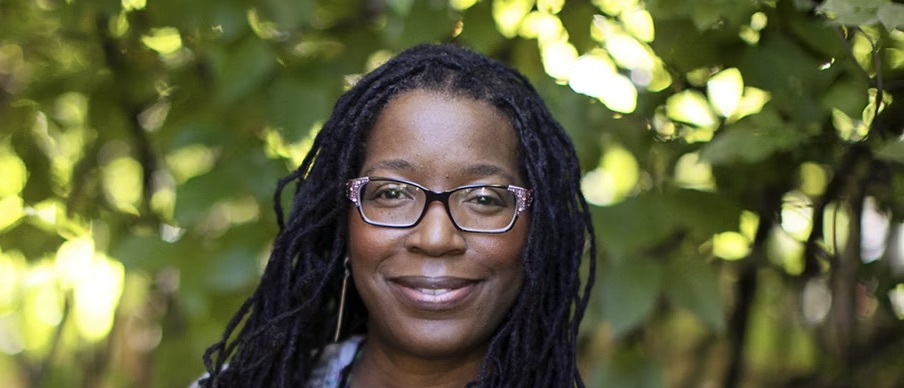
 Tiya Miles was born in Cincinnati, Ohio in 1970. She is the author of nine books. The Cherokee Rose was her debut novel. Her most recent book is Night Flyer: Harriet Tubman and the Faith Dreams of a Free People. All That She Carried: The Journey of Ashley’s Sack, a Black Family Keepsake published in 2021 won the National Book Award for Nonfiction. She is a Professor of History and Radcliffe Alumnae Professor at Harvard University. Visit Tiya Miles at tiyamiles.com.
Tiya Miles is a Nasty Woman Writer.
©Theresa C. Dintino 2025
Works Cited
Miles, Tiya. The Cherokee Rose: a novel of gardens and ghosts. John F. Blair publisher. 2015.




 Donate
