
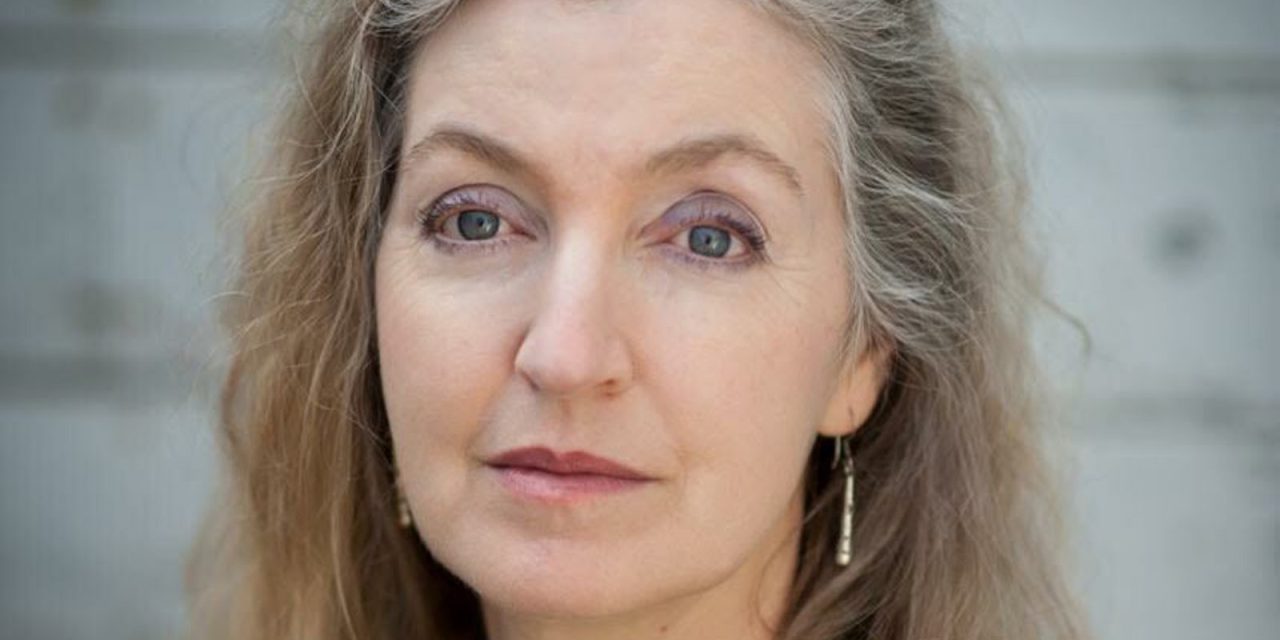
Rebecca Solnit is an historian who writes on the history of San Francisco, the West and the indigenous people of the West. She is also a feminist, activist and philosopher who writes on issues of climate change and social movements. Her book River of Shadows: Eadweard Muybridge and the Technological Wild West (2003), which won the 2004 National Book Critics Circle Award in Criticism, is an astounding achievement.
Eadweard Muybridge (1830-1904), is the photographer who took the first “motion pictures” of horses running on railroad magnate Leland Stanford’s ranch in Palo Alto, California. Muybridge, a man who kept reinventing himself, started out with a bookstore on Montgomery Street in San Francisco, then became famous for his panoramic photographs of Yosemite Valley, murdered his wife’s lover and got away with it, then became obsessed with revealing time through photography and partnered up with Stanford for a series of experiments which led to the successful capture of horses running.
“If one wanted to find an absolute beginning point, a creation story, for California’s two greatest transformations of the world, these experiments with horse and camera would be it. Out of these first lost snapshots eventually came a world-changing industry, and out of the many places where movies are made, one particular place: Hollywood. The man who owned the horse and sponsored the project believed in the union of science and business and founded the university that much later generated another industry identified, like Hollywood, by its central place: Silicon Valley. Hollywood and Silicon Valley became, long after these men died, the two industries California is most identified with, the two that changed the world”(RS 6).
 The history of photography. The history of the railroad. The creation of time zones. The history of Yosemite Valley. The fate of the buffalo. Sitting Bull and the Yellowstone River. Edison. The Modoc War. The arrival of two technologies changing the way we experience the world, time and space, making everything faster, closer, more accessible. All of this is in River of Shadows.
2026, another time when we are undergoing an acceleration of technological innovations that will have profound impacts on our lives and cultures, about which none of us are really sure, was a good time to read Solnit’s book. It was helpful to have this perspective, looking backwards at the conversations and concerns that were being discussed at that previous turning point and considering the outcome.
To try to sum up a Solnit book is to try to count the components of beach sand. Her books ramble and roam, swerve and curve. The reader follows her down dark alleyways and tangents where they suddenly wonder, how did we get here? But Solnit manages to tie it all back together by the end of an essay, chapter or book. It’s quite impressive.
Reading a Solnit book is the experience of having a space opened wide in the psyche and filled with a depth of awe. Solnit excavates the complexities of the world, time and change. We are left with wonderment over where we are headed. What book might Solnit write about our present time if she lived another 100 years?
Rebecca Solnit’s Recollections of My Nonexistence
Solnit is tough. She is scrappy. She had to scratch her way forward to exist. Many of us know or recognize ourselves in her. Those of us who grew up in the 60s and 70s, like her, recall roaming wild around suburban neighborhoods and then further into the open landscapes surrounding them. Many of us remember our parents’ form of hands-off parenting from that era. No helicopters. For Solnit, it had a dark twist: abuse and violence.
This made her angry, and has informed her life and writing. Her essays and memoirs, while separate works, are also one long, continuous piece. Details of her biography are scattered throughout. The reader must be patient because she temps. She teases. She leaves lines like, “a lot of bad things happened in that house” referring to the house she grew up in, yet doesn’t reveal what happened.
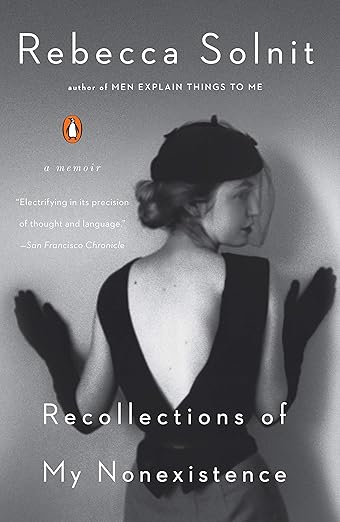 She sprinkles clues but doesn’t elaborate. Rather, she moves on to the stories of other people, which implies they are parallel to her own story. They must be because everything in her books is tangential. But it is mildly unsatisfying. Unsatisfying enough to keep one reading.
Those who persist in continuing to read her are rewarded with more details of her biography along the way. One begins to feel nosy and almost inappropriately interested in her personal life. Voyeuristic. But then they remember that it is she who is leading them along. Leading them along to want to know. It is part of what keeps one reading her books. She is dropping seeds along the way. Breadcrumbs.
She is known as the woman who wrote “Men Explain Things to Me” from which the term mansplaining arose. Her viral popularity arose from that piece, but she had already established herself as a writer, scholar and historian.
“I am a woman who when a poet friend spoke to me of an incident with a nun in Catholic school as “the only time anyone ever hit me” was staggered to try to imagine a life as safe and calm as hers in that respect. I am the daughter of a man who considered it his right to hit women and children and did as his father did before him, and of a woman who had or felt she had for two decades no recourse from that man and no place to register a complaint. … And I am a woman who became a writer and through it gained some standing while writing about other things from art to war, and sometimes tried to put that standing to work to open up space for others’ voices. I am a woman who one morning wrote and essay called “Men Explain Things to Me” that is about the way that the mild disparagement of having your subject of expertise explained to you by a fool who does not know that he does not know what he’s talking about or who he’s talking to is on a spectrum, and the other end of the spectrum is full of violent death”(RN 219).
Men Explain Things to Me
I had heard about it but I never read the actual essay “Men Explain Things to Me” (2008) until after I experienced “mansplaining” so often over a period of months recently that I literally entered “how to deal with mansplaining” into my search engine. It was a series of conversations in which I was repeatedly talked down to, talked over, and had things explained to me by men who I was quite sure knew less about the subject than me.
It came with voices that took up all the space and didn’t allow any space for my voice in the conversation. I began to feel uncomfortable and angry. Then came rage. When I asked myself what was going on, it was this: I’d had enough of being mansplained. So I put those words into my search engine.
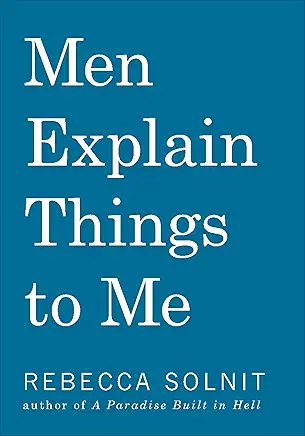 Solnit did not coin the term mansplaining. It was coined by someone who read her piece. And, she asserts, it is not only men who display this kind of behavior. But something in the telling of this story in “Men Explain Things to Me” resonated so deeply with so many women that it birthed a new term for a lot of shared frustration. Solnit is now held up as a heroine for women. A woman who actually gave voice to this .
The famous story is that a man explains a book she has written to her. And when told repeatedly that it is her book he is speaking of, doesn’t seem to register that and continues holding forth to her about her book, of which he has only read a review.
“Yes, people of both genders pop up at events to hold forth on irrelevant things and conspiracy theories, but the out-and-out confrontational confidence of the totally ignorant is, in my experience, gendered. Men explain things to me, and other women, whether or not they know what they’re talking about. Some men.
Every woman knows what I’m talking about. It’s the presumption that makes it hard, at times, for any woman in any field; that keeps women from speaking up and from being heard when they dare; that crushes young women into silence by indicating, the way harassment on the street does, that this is not their world. It trains us in self-doubt and self-limitation just as it exercises men’s unsupported overconfidence”(ME 4).
In the same essay Solnit describes how dangerous this behavior can be and is for women, eroding the basic credibility of women and their voices, and how “credibility is a basic survival tool”(6). She describes how another man told her the story of a woman coming out of her home in the middle of the night in a suburban community, screaming that her husband was trying to kill her as though it were amusing dinner talk, never once considering the woman was telling the truth because that neighborhood was “respectable middle-class people”(6). The moral of the story he told and wanted others to understand is that the woman was crazy.
That women’s voices are credible is at the heart of the ability to address the violence against women that permeates this world on a daily basis.
“Billions of women must be out there on this seven-billion-person planet being told that they are not reliable witnesses to their own lives, that the truth is not their property, now or ever. This goes way beyond Men Explaining Things, but it’s part of the same archipelago of arrogance”(7).
A Field Guide to Getting Lost
Reading a book about being lost, the importance of getting lost, the lost, the unknown, adventurers, adventure, exploration, lost histories, lost people, and being found is especially wonderful when it is written by Solnit who has proven herself to be an astute guide through the unknown. She is not afraid to take those trails that look grown over and abandoned, or to explore wilderness that has unknown threats and hidden stories, abandoned gods and long forgotten dreams.
“Lost really has two disparate meanings. Losing things is about the familiar falling away, getting lost is about the unfamiliar appearing. There are objects and people that disappear from your sight or knowledge or possession; you lost a bracelet, a friend, the key. You still know where you are”(22).
Within A Field Guide to Getting Lost are chapters titled “The Blue of Distance,” which are meditations on blue. The first use of blue to show distance in painting, then the blue of eternity, of nothingness, the blue of emptiness, the blue of expanse, of mystery, the blue of the sky.
“In the fifteenth century, European painters began to paint the blue of distance. Earlier artists had not been much concerned with the faraway in their art. Sometimes a solid wall of gold backed up the saints and patrons; sometimes the space curved around as though the earth were indeed a sphere but we were on its inside. Painters became more concerned with verisimilitude, with a rendition of the world as it appeared to the human eye, and in those days when the art of perspective was just arriving, they seized upon the blue of distance as another means of giving depth and dimension to their work”(29).
Things that seem or look blue at a distance look different when seen up close.
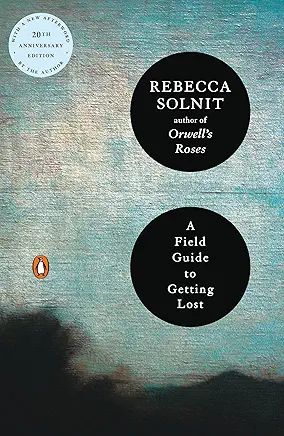 After following Solnit through the philosophy of being lost, and The Blue of Distance over many chapters, we reach the final chapter, “One-Story House” where she learns something about her dad that changes things. She is visiting the area she grew up in, Marin county, California, with a friend who is speaking to her of all the ways the ecosystem has been recovering in the past few years, the animals returning, thanks to the conservation efforts of the 1970s. The crested egrets, the tule elk, the elephant seals, and countless species of birds have returned.
“I found a book at the house I was staying at, about how the land on which these creatures flourished was protected from development, and found my father’s name in the index. We moved back to California when he was hired to write the master plan for the county, and he spent the next five years working on a document that protects from development most of its western portion that wasn’t already under state, federal, or land-trust protection”(202).
Al Solnit, her father, came under fire for this and received a lot of hateful energy and letters from local businesses.
“The plan “went through fifty-seven public hearings and was adopted in 1973 . . .Solnit was the victim of vicious attacks by developers and hostile editorials”(203).
When she discovers this book all these years later, she realizes it was most probably one of these interactions he was coming home from when he woke her up violently one night when she was nine.
“One summer evening when I was about nine, my father came home late and found a forgotten glass of chocolate milk gone sour on the kitchen counter. Waste enraged him, and since I was the principal drinker of chocolate milk, he rushed into my room, flicked the light on, and dashed it in my face as I slept, so that I woke up dripping with a giant roaring over me”(203).
Here, at the end of the book A Field Guide to Getting Lost, Solnit, “finds” her father, locates a part of him she can relate to, even perhaps be proud of, which helps her make meaning of other things that have been disorienting and confusing, mysterious and ominous. It is less a healing than an understanding that resonates out into the larger world. It locates Rebecca Solnit and her personal story into a larger history. It offers her context, which is how Solnit makes sense of things. Her books do the same for her readers.
“The house, was a small place inside a larger one, or a small story inside a larger one; picture the stories nesting like Russian Dolls, so that terrible things were happening in that house, but they were tied to the redemption happening on the larger scale of the county, which was in part a reaction to the violent erasures going on across the country and the world. I had left the house for good a quarter of a century before and just gotten out of it in my dreams over the past year, but the county was something I chose to return to again and again, and on this return I’d seen the nesting of those stories, as well as some of the animals that had come back”(204).
Rebecca Solnit is a Nasty Woman Writer.
©Theresa C. Dintino 2026
Featured image by Jude Mooney Photography
Works Cited
Solnit, Rebecca. A Field Guide to Getting Lost. Penguin Books, 2005, 2025.
___________. Men Explain Things to Me. Haymarket Books. 2014.
___________. Recollections of My Nonexistence. Penguin Books, 2020.
___________. River of Shadows: Eadweard Muybridge and the Technological Wild West. Penguin Books, 2003.







 Donate
