

We need not dwell in great detail on Rachel’s life, because unlike her, it was utterly typical of many Jews from her time and place. Born in Russia in 1890, a visit to Israel in 1909 turned into a lifelong commitment to the pioneering, agricultural resettlement of Israel—the realized dream of a people who hadn’t an acre to call their own for two millennia.
Rachel was the first to forge for Hebrew a literary idiom from everyday speech. She drew on scripture, but didn’t touch on Esther and the figure of Wisdom from the Book of Proverbs. She sensed that these were not archetypes of the feminine, but male fantasies about women, sequestered by reverence into what amounted to a theological harem.
Rachel turned instead to the marginalized women of scripture, whose feeble silhouettes gave freedom to her prophetic imagination—and whose subordinate status demanded redress.
While Biblical personae, even Biblical women, are a constant feature in western literature, they tend to be two dimensional, allegoric characters. True, from time to time a narrative genius like Dante arises, who makes them flicker into life for the length of a vignette, but even then they are merely blessèd poster girls for male propaganda.
Rachel, by contrast, makes the characters substantially, physically real. She does not merely reimagine them, because for her they are not “other.” She is possessed by them. This is most famously displayed in the poem Rachel,
Rachel
The voice you recognize in my songs
is hers, as surely as the blood in my veins
flowed in hers, my far fore-mother,
it flowed in hers, the same.Any house seems small,
all indoors has the feel of a trap.
I’m never at ease in a city,
never understood the appeal of an address.What can I say, except that I came
from that same Rachel whose scarf fluttered free
as a nomad’s banner in desert wind?I always know where I’m going,
don’t need sign or map or even street
to keep to the path that’s mine alone.
My legs remember, my feet repeat:
Rachel!
—as she went then, so now I go.
Rachel also possesses what we would nowadays call an ecological awareness, and a connection with the land that is almost pagan in its intensity. We see this very clearly in the following poem, in which she subtly lays claim to the status of high priestess.
In the Garden
A morning in early September
—in Hebrew, the month of Elul—
dawn’s pink and blue, the world is new
after the heavy deadening heat
of Israel in August,
this cool dewy day feels like forgiveness.Maybe I’ll rise, shake myself awake,
brush off yesterday’s dust,
trust that tomorrow’s a different,
not just another day?
Maybe I’ll shoulder the yoke of existence,
my humbled, my humiliated heart
accepting, even blessing God’s decrees?A young woman comes among the furrows and rows
of this vegetable garden in the Galilee.
She turns the spigot, the tap shudders, sputters,
gushes. Now she sprinkles life
as once the high priest sprinkled blood
on the atoning altar while the temple stood—
she offers water,
a gentler, better intercession.
Not a stalk athirst forgotten,
not a shoot left out.Maybe she’ll forgive even God
his arbitrary heart,
maybe find it in her own
to make a new start.
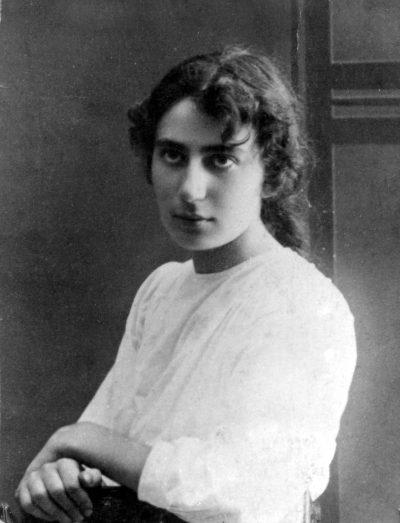
A young Rachel Blaustein.
Nowadays we call this a poetic creation, a work of imagination. In antiquity her achievement would have been called prophecy, and perhaps we should apply this term anew, calling her poetry prophetic just as we do William Blake’s, recognizing that she is, like Blake, not writing mere poetry but addressing existential concerns on the deepest levels of human reality.
In this next poem, where Rachel alludes heartbreakingly to the tuberculosis which brought about her early death, she also gives unabashed voice to the occult aspect of her spirituality.
At Night
Then said Saul unto his servants, “Seek me a woman that hath a familiar spirit, that I may go to her, and inquire of her.” And his servants said to him, “Behold, there is a woman that hath a familiar spirit at Endor.” —1 Sam. 28: 7
Strewn around me on the bed,
on the pillow, on the blanket,
letters, old letters, so many, all saved.
I bend intently over them, try to divine
some pattern—like the witch of Endor
who summoned up the ghost of the prophet Samuel
for Saul, Saul who feared the next day’s battle,
who felt God’s silence and guessed what that meant.The witch of Endor sang to the dead,
the ghosts approached, rose from the ground.
Like her, I must act as necromancer,
I talk to my ghosts, they foretell nothing good.She asked for Saul’s the outcome of battle.
Unlike her, I’ve no need to ask.
I summon no Samuel, it needs no prophet
to tell me how little future I have.
I’m more like Saul, abandoned by God,
I know in my heart that I’m already dead.
We have grown accustomed to women reclaiming negative images of the feminine in general, and of witches in particular—as in Anne Sexton’s programmatic Her Kind. Rachel’s evocation of this figure is of a different order, since in her case geography, language and race coincide in a dramatic atavism. Rachel’s words carry metaphysical conviction.
Spring
And here you are again,
forgiving, coaxing, soothing—
my heart catches fire afresh.Each spring they come to Tiberias
by thousands, to pray at the grave
of the second century CE sage,
wonder-working Rabbi Meir—
they kindle bonfires on the hills
overlooking the Sea of Galilee,
now, as they have for eighteen hundred years.My heart’s a fire like that,
a flame defiant of time.My covenant’s with the rocks of Israel’s hills;
my friends—fish hidden in the Sea of Galilee.
The leaves of my Bible are those on these trees,
I follow Solomon, the great magician,
instructed by demons and served by djinn.My words are the sounds heard only at night,
it was sunlight itself that taught me joy,
my Torah scroll is the map of this land.
I cannot scold this truant spring—
I must trust this child of time, take his hand.
A feature of Rachel’s poetry which is particularly and uniquely female is what I call “sociable nature.” Because women are better socialized than men, and their engagement with the world is usually more immediate and less abstract, nature often appears in women’s poetry as a sentient and interactive community. Men tend to project upon nature their own moods and concepts, in a dominant way. They reformulate the material world. Women engage it differently and more amicably.
Though we see something like this in myths and folktales and in children’s stories, in the first case this is done in the service of explaining nature; in the second, the aim is to tame nature to the level of toys. The feminine vision of sociable nature bespeaks a far more equal involvement. This is not to say that men are incapable of taking a friendly view of nature, there is of course the famous “peaceable kingdom” passage in Isaiah, where the lion lies down by the lamb and the child plays safely at the adder’s door—but this vision is achieved only by the hardest. It takes an entire apocalypse to bring about what a female poet sees as a matter of course.
It is best instanced, in Anglophone poetry, by Emily Dickinson, in her programmatic lines,
Several of Nature’s People
I know, and they know me—
I feel for them a transport
Of cordiality— (1096)
Rachel’s Dickinsonian sociable nature, is strikingly visible in the poems where Spring in personified, in Alas, my sad homeland . . ., but never more winningly than here,
The Sea of Galilee
Here are the Golan heights,
stand on their green slopes,
reach out and touch their white limestone.
The silent calm of this mountain range
makes you stop, look long, look far, look north—
to Mount Hermon, grandfather, ancient of days,
his snow-hair radiant, sublime and sole.
Cold, the winds gusting down from his white heights!Look down now, to the Sea of Galilee,
see that palm tree with its unkempt crown of fronds,
disheveled like the hair of an unruly boy—
see its shape, how it’s grown—
it looks like it slid down the slope
to the very edge of the water
as if it meant to raise root and go wading!And the flowers down there by the city of Tiberias,
blood-colored anemone, golden crocus—
there are days you’d swear the grass
was seven times greener, the sky
as many times bluer than ever you’d seen.If I were driven back into exile,
penniless, bent, forced to live in lands
where the Jew will always be a stranger,
a guest at best, I’d never deny
how good you were to me, nor foget the love I felt
for you, the divine loving-kindness
that allows me to live here now, while I’m young.
The reception of Rachel Blaustein’s poetry is one of the sad paradoxes of women’s literature. Though she is taught in all Israeli schools, her estimation has suffered as much from her admirers as from her detractors.

Recently published translation of Rachel Blaustein’s poetry by author Mildred Faintly.
Rachel was a contemporary and friend of Haim Nachman Bialik, and she is fairly reckoned to be the mother (as he is the father) of modern Hebrew poetry.
Rachel was the only first-rate woman poet to write in Hebrew since the eleventh century BCE when Deborah composed her great war-song (to be found in the fifth chapter of The Book of Judges).
Yet she is conspicuously absent from serious anthologies of Hebrew poetry. T. Carmi’s Penguin Book of Hebrew Verse, like his magisterial The Modern Hebrew Poem Itself are parade examples of this omission. That Carmi, a brilliant poet and literary critic, and a great-hearted generous individual, would think Rachel unworthy our attention, requires explanation.
Any survey of modern Hebrew poetry begins with Bialik, whose greatness is unquestionable. He brought to his verse a rich background of Talmudic learning, matched by a profound acquaintance with the poetic world of Pushkin and Lermontov.
At this point in the usual accounts, Rachel, Bialik’s contemporary and fellow Russian, is dismissed, with condescending praise for her naïve and innocent genius. We are told she wrote with freedom and simplicity because she didn’t know any better.
This hardy fable of Rachel, the untutored genius, is of a piece with the similar suppositions applied to Robert Burns. Burns was reinvented as a genius ploughboy to explain the freak phenomenon of his writing that well without being English. Thus, Burns could be praised and belittled in the same breath. In the case of Rachel, a similar tale was made to explain (away) how she could be so brilliant without being a man.
The first terrific stirrings of modern Jewish women’s literature begin with Rachel. She offers anew all the insights and emphases that characterize Jewish genius—moral warmth, ironic self-awareness, and unfaltering affirmation of life in this world, writ large in the unrehearsed and urgent cursive of self-discovery.
Rachel Blaustein is a nasty woman poet who brought a dead language back to life.
© Mildred Faintly
Bibliography
Flowers of Perhaps: Selected Poems of Rahel. Translated by Robert Friend with Shimon Sandbank. London: 1994.
Gluzman, Michael. “The Invisible Revolution: Rereading Women’s Poetry.” In The Politics of Canonicity: Lines of Resistance in Modernist Hebrew Poetry. Stanford, CA: 2002.
Rachel Blaustein, Complete Poems. Translated by Mildred Faintly. Independently Published, 2024.
The Defiant Muse: Hebrew Feminist Poems from Antiquity to the Present. A Bilingual Anthology. Edited by Shirley Kaufman, Galit Hasan-Rokem, and Tamar S. Hess. New York: 1999.






 Donate
