

Abstract Artist Agnes Pelton’s (1881-1961) work was lost to the public since her death in 1961, coming back onto the scene in a big way in 2019 with the Phoenix Art Museum’s exhibit and accompanying book Agnes Pelton, Desert Transcendentalist. This returned the necessary acclaim and value to the artist and her work and saved her from erasure.
However this would never have happened without artist Jan Rindfleisch’s efforts beginning in 1979.
Without Jan Rindfleisch, we wouldn’t know Agnes Pelton.
Read Nasty Women Writers post: Abstract Artist Agnes Pelton (1881-1961) Liberation in the Desert
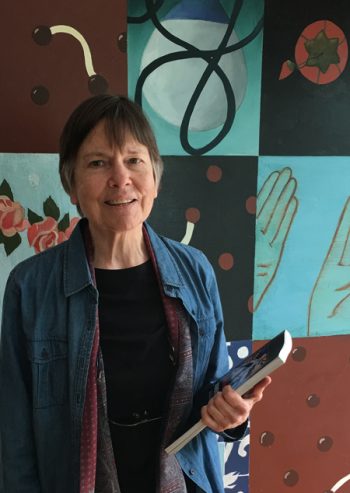
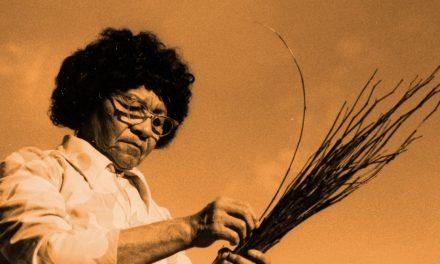
Jan Rindfleisch in front of a painting by José Arenas, from whirligig website.
Rindfleisch, who passed away in 2025, became an artist in her own right after studying physics in college, followed by a long career teaching the arts and 32 years as director of the Euphrat Museum at De Anza College in Cupertino, California. Rindfleisch dedicated her life to bringing forward the works of local artists in her own community, inclusive exhibition agendas, and uncovering artists who had been forgotten or lost. She also started her own publishing company, wrote books and was beloved in her community.
The story of Rindfleisch, together with a group of other artists, discovering and returning Pelton to the art world is almost as inspiring as Pelton’s story.
The story also sheds light on the importance of archives, the politics of art and archives and the repetitive cycle that keeps women and other minority artists out of the archives and, therefore, also the public arena.
In an article “The Untold Backstory of the Agnes Pelton Renaissance,” on the California Desert Art website, Jan Rindfleisch informs us about the origin of the return of Pelton to the art world:
“The following untold backstory begins around 1979 when I was director of the Euphrat Gallery at De Anza College in Cupertino, California. To uncover information about several neglected artists, I approached the Archives of California Art at the Oakland Museum of California and started working with Michael Bell, then registrar/cataloger for the museum art department; George Neubert, then chief curator for art; and three graduate students from San José State University. In the research process, Bell showed me Agnes Pelton’s 1934 painting Orbits and said works like these would not be exhibited unless there was the story, the critical writings and documentation, to go with them. I was stunned. My motivation skyrocketed.”https://www.californiadesertart.com/awakenings-an-untold-backstory-of-the-agnes-pelton-renaissance/
At the time many California artists felt “locked out” of the established art world. Others felt marginalized, including women and people of color. There were also many art forms dismissed at the time as “craft”.
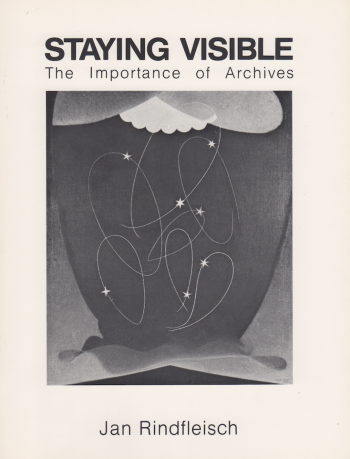
In the introduction to the book Staying Visible published in 1981, Rindfleisch writes:
“This project began two years ago. Its purposes were to search California and national archives and find out what information was already available about several neglected artists; to collect more information, to make a challenging and visually exciting gallery show room the project to put the newly acquired information in the archives (so that others would have the chance to review this work, and find something more than we found)-and to publicize the importance of “saving stuff” in keeping an artwork and an artist visible”(1)
Archives are significant because they hold the records of what we as a culture think is important to remember. When Rindfleisch began, there was a dearth of interest in California art and a lack of archived information on women artists. This created a self-fulfilling cycle. If there is nothing in the archives, then an artist’s work is not viewed as valuable and if women artists and those around them don’t view their work as important, they don’t archive.
 Rindfleisch and her collaborators also discovered that many of those same artists who felt locked out neglected to archive their own art and personal papers, thereby feeding into the cycle of disappearance and erasure. Unfortunately, it is the job of the artists and those around them to maintain a close watch on what they consider pieces that would be valuable to the archives and take themselves seriously enough to do this. They also must take care to document their work and store it.
Then artists need to find an institution willing to house their archives. As Rindfleisch discovered, it doesn’t matter how “good” your art is; if there is no archive to support it, very few museums will show it.
Together with Margaret Stainer, a graduate student at the time who spent decades on the research project about Pelton, Rindfleisch began searching for materials to archive about Pelton to help her meet the requirements needed to have a show.
She located Cornelia and Irving Sussman, Pelton’s neighbors and friends and others who had known Pelton in her lifetime. They offered correspondence, journals, artwork and financial assistance. They also had stories to tell that were recorded.
Pelton painted the following “You Both Make the Desert Flower” for the Sussmans in 1953.

Agnes Pelton. You Both Make the Desert Flower. 1953
Rindfleisch continues:
“We conducted research, exhibited the art, and published the book Staying Visible: The Importance of Archives in 1981 in conjunction with the Euphrat Gallery. Eleven artists were identified, researched and profiled in essays: Agnes Pelton, Beatrice Wood, Marjorie Eaton, Consuelo Cloos, Leila McDonald, Joyce Treiman, E.F. Evans, Therese May, Patricia Rodriguez, Mildred Howard, Carmen Lomas Garza”(https://www.californiadesertart.com/awakenings-an-untold-backstory-of-the-agnes-pelton-renaissance/)
Rindfleisch relays how this was an all-volunteer effort constantly struggling to survive.
In the article on Pelton in the book Staying Visible, Margaret Stainer writes:
“To think one could paint Orbits in 1933 and many more later, and be virtually unknown makes me question the process of art history. How is it that a fine woman Painter, active for over half a century, who exhibited in the Armory Show and in major museums across the country, could be so obscured from view?”(9).
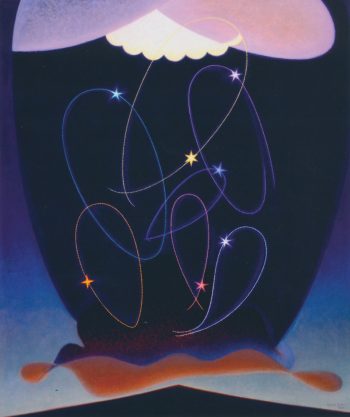
Agnes Pelton, Orbits. The Oakland Museum.
In a footnote of that same article is this story of how Orbits was recovered:
“George Neubert saw Orbits high up on a wall in a “hippie-run junk shop” in Venice, California, selling for $75. He found it “interesting and strange,” saw a museum label on the back and said, “I’ll give you $150,” buying it for the Oakland Museum permanent collection.”
That is not the only one of Pelton’s paintings that was located in a junk shop. Many others were found at yard sales as well.
When the Agnes Pelton exhibition opened in Phoenix Art Museum in 2019, 40 years after Rindfleisch’s initial discovery, the following was included in the text on the wall.
“Pelton’s slow re-emergence within the margins of American art began through critical and academic re-evaluations of her place in art history. In the 1980s, archival efforts aimed at establishing a baseline of primary research materials began to take shape. The Agnes Pelton papers at the Smithsonian Institution were assembled by Cornelia and Irving Sussman for a biography of Agnes Pelton. They were donated to the Archives by gallery director Jan Rindfleisch on behalf of the Sussmans, in 1984. The majority of her works were cataloged in a publication for an exhibition curated by the art historian Margaret Stainer in 1989, her first solo exhibition since 1955.”
This was a true victory lap for Stainer and Rindfleisch, not to mention Agnes Pelton.
The problematic archives
The Archives of American Art at the Smithsonian Institute seems to be held in highest regard. Then there are museums, universities and libraries that house archives as well. But they appear to be hampered by politics and bias toward white men.
Artist Judy Chicago tells the story of how the archives of her The Dinner Party installation were turned down by the Smithsonian.
Read Nasty Women Writers Post: Judy Chicago: Feminist Art, Collaborative Works and Changemaker
Eventually, Chicago’s archives for The Dinner Party and the rest of her work, along with documentation and correspondence, found a home in both the Schlesinger Library for the History of Women in America and the Penn State University Libraries. But it was a long, hard fight. Chicago emphasizes the need for women artists to be better educated on how to store, document and archive their own work. Men seem to know how to do this, she noticed; she had to teach herself.

Judy Chicago with one of her paintings on a car hood. photo by Donald Woodman. wikimedia commons.
Chicago is an artist who has carried out miraculous amounts of work to bring lost or forgotten women artists back to the forefront. This is, in fact, the theme of The Dinner Party, which the Smithsonian ironically rejected as uninteresting and unimportant when they were queried. A double insult. First, the women artists were erased and then the woman who tried to unerase them was rejected.
Read Nasty Women Writers post: Feminist Artist Judy Chicago’s The Dinner Party: Celebrating Women Across Time.
When the Smithsonian came back to Chicago years later with an invitation, Chicago respectfully declined. Chicago urges women artists to take themselves seriously, document and archive. Your archive is your legacy.
She also notes how little has changed for women in the art world in this way.
“Many young women artists—who had been hoodwinked into thinking that everything had changed—were shocked by the September 2019 ten-year study by Artnet News, which demonstrated that ”Just 11 percent of all acquisitions and 14 percent of exhibitions at 26 prominent American museums over the past decade were of work by female artists.” And only 3 percent of the women artists were African American”(Chicago 209).
In his foreword to the book, Staying Visible, Paul J. Karlstrom notes how what is in the archives dictates what we as a culture believe is worth remembering. It is our collective memory.
“The importance of this source material really cannot be overestimated; without it our understanding of ourselves as cultural beings, products of a rich creative history that has formed our present identity would be fragmentary and out of focus. Intelligence depends upon the ability to retain, process, and interpret information. The Archives in the service of the collective national intellect, functions as the memory of art in America“(IV).
To have this archive so skewed toward white men is an inaccurate memory indeed.
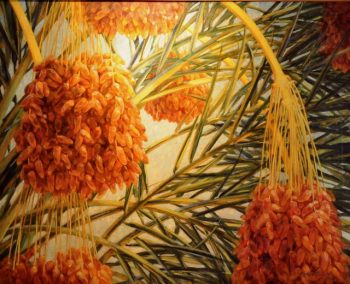
Agnes Pelton, Seeds of Date, 1935, oil on canvas, 41 × 35″. Collection of Palm Springs Art Museum.
A culture preserves what it believes is meaningful in its history. Out of that arises its story. The stories that get told reflect what is valued in a culture. Jan Rindfleisch reclaiming Agnes Pelton is an example of how being proactive about what is archived influences that story, our story.
Jan Rindfleisch is a Nasty Woman Artist.
© Theresa C. Dintino 2026
Featured image taken from californiadesertart.com. Agnes Pelton painting in Cathedral Canyon, 1939. Photo courtesy of San Francisco Museum of Modern Art, as seen in Jan Rindfleisch’s book Staying Visible.
Works Cited
Chicago, Judy. The Flowering: The Autobiography of Judy Chicago. Thames and Hudson, 2021.
Rindfleisch, Jan. Staying Visible: The Importance of Archives. De Anza College, 1981.





 Donate
