

Three brigantesse: Filomena De Marco aka “Pennacchio,” Giuseppina Vitale, and Maria Giovanna Tito.
A brigantessa is an Italian term for a female brigand. A brigand is a member of a band or group who lives by plundering others.
Most don’t wake up one day and decide on brigandage: to rob others for themselves and their people. Typically, a corrupt and unfair social situation that creates hardship spurs the development of such radical behavior, creating a dangerous environment for all.
Rosanna Micelotta Battigelli’s novel La Brigantessa is set in a place – Southern Italy – and a time – mid-19th century – ripe for such an illicit lifestyle.
Author Battigelli explains:
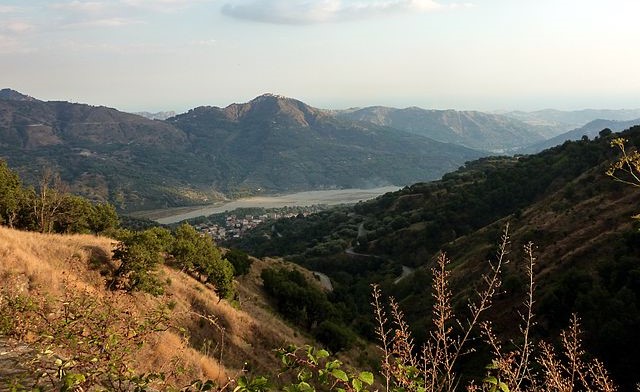
“This was a troubled time, where peasants were rebelling against the harsh policies of the newly formed Piedmontese government. Unification had resulted in increased taxes, unilaterally imposed upon the country by a northern government that didn’t understand or care to understand the people, and the particular circumstances of the south. The Southerners believed that despite the challenges of living under the previous Bourbon regime, unification resulted in even worse conditions. Desperate in the face of increasing poverty, many rebelled and turned to the dangerous life of brigandage. They were forced to go into hiding in wild territory such as the Aspromonte mountain range, where the dense woodlands and caves provided refuge and safety”(Cusmano).
Brigandage wasn’t a new or unusual global phenomenon. Where corruption is the norm rather than the exception, inevitably resistance will crop up. In the 1860s, the increasingly unfair social and economic conditions the Southern Italian people faced and the mountainous terrain they knew well presented an ideal setting for bands of brigands to flourish.
Female brigands, although not common, did exist. There are some notorious brigantesse who wielded weapons and carried out robberies and murders in the name of what they believed was justice for themselves and their people. Most well-known is La Brigantessa Michelina Di Cesare (1841-1868), whose photograph is on the award-winning cover of Battigelli’s book.

La Brigantessa won best cover design in the 2019 International Book Awards. Credit goes to Val Fullard, Creative Director at Inanna Publications.
A Writer’s Journey Home
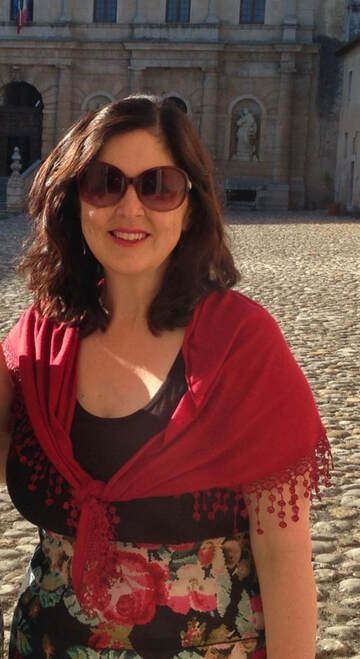 Rosanna Micelotta Battigelli was born in Calabria, Italy. Her family immigrated to Ontario, Canada when she was three years old. Growing up, her relatives shared many stories about that region of Italy and the Risorgimento or revolutionary leader Giuseppe Garibaldi. Intrigued, Battigelli wanted to know more about this so-called Decade of Fire (1860-1870) and share this history with others. Most importantly, she wanted to get to know her ancestors better and to honor them.
“Researching and writing this novel allowed me to take a metaphorical journey to the land where I was born, and to use my discoveries to highlight a part of Italy’s history that is little known or understood. Naming Gabriella’s hamlet “Camini” was an indulgence I permitted myself, since Camini, Reggio Calabria, is where I was born. Although I was only three when my family immigrated to Canada, I have always felt a strong connection to my motherland and to my relatives in the south. In writing this novel, I wanted to honour the lives and sacrifices of my parents and ancestors, and the people of Camini and Calabria in particular”(Cusmano).
Life Interrupted
This historical novel begins in 1862, following the start of earnest unification in 1861. As the story unfolds, Battigelli provides useful descriptions of the ongoing political upheaval:
“General Garibaldi’s victory in ousting the Bourbons under King Francis II from the southern territories in The Kingdom of Two Sicilies has brought changes none of them could have foreseen. How many bodies maimed and lives lost to become one nation under King Victor Emmanuel II! Months after Garibaldi’s victory in Naples and Sicily, the territories were called to pledge their allegiance to the new State by way of a plebiscite. And those voting “yes” seemed to be enjoying special privileges in the aftermath of Unification”(Battigelli 13).
We meet Gabriella in the town of Camini as a young adult, one who has lived a more comfortable life than most peasants because her family works for and lives with the local priest, Don Simone. Yet, Gabriella too has experienced hardship, losing her mother during the birth of her younger brother Luciano.
Brigand chief Stefano Galante notes this difference between Gabriella and other peasants later in the story:
“She lacks the skin that is the colour of tallow, and the weather-lashed face of one who spends dawn to dusk in the fields. Inky shadows do not hang under her eyes that have long lost the glimmer of hope for a better life”(206).
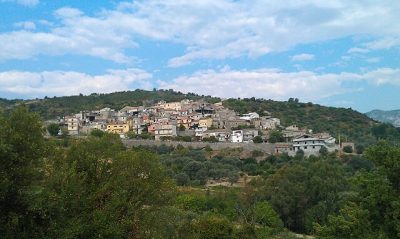
Camini, Calabria, Italy
It’s true: Gabriella is a bit more fortunate than most. She is described as hardworking, kind, and beautiful. Her love interest is Tonino, who is also portrayed as a hardworking and upstanding individual. Life has its challenges, but her strong religious faith helps her cope. This is until Tonino is persuaded to join Garibaldi’s Red Shirts to fight the two hold-outs in the unification, Rome and Venice. This is an unwelcome disruption in Gabriella’s life, but when the church property is sold to a wealthy Northern Italian businessman, her life is dramatically altered.
When the new landowner Signor Alfonso Fantin arrives in Camini to check out his purchase and decide his next move, he attempts to rape Gabriella, who stabs him in self-defense. Before stabbing him, he slaps her hard across the face for resisting his advances:
“Now Gabriella, that could have been avoided. Has no one taught you your place?” He has deliberately omitted the “Signorina.” She is a peasant, after all. There is no longer any need to pretend at polite conversation of speech”(85).
In the chaotic aftermath, Don Simone is well aware of Gabriella’s place as a peasant girl who doesn’t stand a chance against wealthy Signor Fantin. Therefore, he flees with her and her brother, searching for sanctuary. (Their father, Lorenzo, has been killed in a scuffle when he comes upon Signor Fantin attacking Gabriella.)
After hours of travel in a wagon pulled by mule over rough terrain, Gabriella, inconsolable and in shock, is described as receiving comfort from her deceased mother (ameliorating the reader as well, after such a devastating turn of events):
“Closing her eyes, she feels the presence of a quieting, calming hand, and without a doubt in her mind, she senses that her own mother, Elisabetta, is with her. Gabriella fishes for her mother’s handkerchief in her pocket and wipes her tears. Letting out a long, drawn-out breath, she allows herself to drift to sleep”(138).
Don Simone and Gabriella leave young Luciano at a convent in the care of nuns and continue to search for a safe space. Separated from all she knows, Gabriella begins to hear and trust her inner voice. At one of their stops where they are supposedly welcome and will be safe, Gabriella heeds the bad feeling she has and insists that they must move on. She has never gone against the priest’s commands, but things are shifting in Gabriella’s heart and mind.
“I’m not staying,” she says with the calmest voice she can muster. She draws out a long breath, fully aware that this is the first time she has defied Don Simone. Whatever demon has seized her soul to make her act this way, she has no intention of fighting”(174).
Ultimately, they end up in the protection of a brigand and Gabriella begins to realize that life is a lot more complicated than she once thought.
“Perhaps nothing is as it seems, she thinks bitterly”(175).
Her faith in God has been shaken. She no longer accepts what she is told to believe, even from Don Simone:
“It’s amazing how money and position can make the law blind and deaf to what’s right.” His eyes harden. “Don’t worry, my dear, God’s law will eventually prevail. The real villains will all have their day of judgment before Him.”
“Gabriella frowns. What comfort can she possibly get from knowing that judgment will not happen until Judgment Day?”(219).
She also begins to understand and sympathize with the brigand.
“Mere days ago, she thought of the brigand chief as nothing less than a monster, yet now she feels a surge of hope that he is alive and has thwarted Colonel Russo and the forces of law. For it is the law that failed Stefano, his sister, and countless others who have been trod on by the wealthy and entitled, and who have suffered injustice and humiliation with no recourse but to take to the hills and skulk like wild animals with the constant threat of pursuit, capture, torture, and death. Or life imprisonment, if luck is on their side”(351).
Gabriella is temporarily cornered into the life of a brigantessa. When she is about to be killed, her first thought is her family: what will they do without her? She doesn’t think of herself even in such a dire situation and she questions such a mindset:
“All her life she has thought about others. Done for others. Tended to her father, a shadow of a man since his wife died. Cooked for him, cleaned, tried to bring him some comfort in his grief. Put on a brave face while grieving herself. And Luciano? He might as well have been her son; she has been more a mother to him than a sister. Other than suckling him, she raised him almost from the beginning. Without complaint or remorse, she has spent her youth and young adulthood sustaining both of them. And she has also done her part for Don Simone. Kept house, tended his animals and garden, cooked, washed. Yes, he, too, is family. She has done it all for her family. And she has never looked at taking care of the ones she loves as a hardship.
“But now she can’t think about them anymore. She must think about herself. Yet why is this so difficult to do?”(339).
It’s difficult because it hasn’t been allowed, nor has it been acceptable. Her life, like most girls and women, is expected to be about helping and serving others, and its value is measured thus. Perhaps now that she has saved herself by doing what she would have found unfathomable only weeks earlier, she can live more freely. (Gabriella receives an unexpected pardon from Colonel Russo, a Piedmontese general charged with disposing of brigands, after he hears her story in its entirety.)
In the end, there is loss, grief, and trauma, but Gabriella has also stepped into herself as a brave, self-sufficient woman, and although forever changed, the life in front of her feels vital and precious.
Rosanna Micelotta Battigelli is a Nasty Women Writer paying homage to her ancestors and the courageous resistance of the Brigantesse.
© Maria Dintino 2025
Works Cited
Battigelli, Rosanna Micelotta. La Brigantessa. Inanna Publications and Education Inc, 2018.
Cusmano, Liana. “Rosanna Micelotta Battigelli on La Brigantessa, Her Historical Novel Set in 19th Century Calabria.” Accenti, 31 October 2019. .” https://accenti.ca/ROSANNA-BATTIGELLI-ON-LA-BRIGANTESSA-HER-HISTORICAL-NOVEL-SET-IN-19TH-CENTURY-CALABRIA/




 Donate
