
Introduction
I began to study Chinese because I was vastly impressed by a mediocre translation of the poem “Encountering Sorrow” in the old Cyril Birch Anthology of Chinese Literature. This poem, a third century BCE shamanic tale of doomed homosexual love, in the form of a catalogue of flowers, was the most wondrous thing I’d ever read as a twelve-year-old girl in backward, rural Rhode Island.
I continued to study Chinese in college, despite my own grave doubts about my ability to learn so difficult a language. It turned out those doubts were not entirely misplaced. Had I known I would spend the next two decades memorizing cryptic little pictures and blackening reams of paper with practice brush-strokes, I might never have signed up for this “journey to the east.”
I studied the language in a very traditional way. I began with the Confucian Classics, a hefty collection of frequently unintelligible ancient texts which became the Bible of Chinese civilization about the same time our hefty collection of frequently unintelligible ancient texts were compiled into our Bible. I then devoted myself to medieval Chinese literature, that is to say the great Tang poets, especially Du Fu. Finally I turned to the last phase of premodern Chinese literature, vast novels like Journey to the West and The Dream of the Red Chamber.
I never concerned myself with modern, spoken Chinese, since I had no interest in annoying restaurant staff, or translating business documents. This attitude, worthy of a Song Dynasty scholar-recluse, meant that, when university jobs were replaced by adjunct gigs, I became entirely unemployable.
This was actually a great stroke of luck. Had I gained tenure, I’d have passed my days commenting on commentaries, darning, as it were, the socks of Sinology. I would have finished, someday, writing my profound treatise on Neo-Confucianism, insulated from anything more relevant.
But when the Supreme Court overturned Roe v. Wade in 2022, in the most shameful judicial decision since 1859 when Taney’s court upheld the Fugitive Slave Act, I felt my identity as a woman with an outrage that extended to my field of expertise. I had hitherto acquiesced in the academic accommodation to feminism, which admits a few mediocre women authors to the canon, and politely suffers a certain amount of unfocused (and thus impotent) man-bashing in scholarly articles no one reads. This paralleled third wave feminism, which set aside structural demands in consideration of flattering but petty concessions. Trump’s re-election shows how much is still unachieved.
Sinology began as a missionary enterprise. The first dictionaries were compiled to translate the Bible for the spiritual rescue of the Yellow Man. Though this crude colonialism has evaporated, the underlying conservatism is unaltered. And the fiscal extinction of the humanities in universities has ensured that no new blood renewed the point of view.
Thus, when I regarded Chinese literature through the lens of feminism, I was astonished to discover vast tracts of women’s creativity which had been culturally appropriated by male culture, and whose provenance has never been questioned by the tenured pundits of Sinology—beginning with the Chinese characters themselves. What I have discovered has been discounted, because I am unable to cite previous work which would confirm that what I say has not yet been confirmed. In the words of one reader of this essay for an academic journal, “If this were true, I would already know it.”
A Closer look at the Characters
Written Chinese is attested from as far back as the thirteenth century BCE, and began to evolve at least a thousand years before then. The standard Chinese writing familiar to us, the angular characters written with a brush, came into being around the beginning of the common era.
These characters are usually composed of an image for what is meant, and another element added to suggest the sound. The characters were abstracted from their earlier, more pictorial forms for ease of writing, and also due to the use of ink and brush to write them. Any deeply curved line would fill with ink and become illegible, so straight lines predominate, as in the character for “mouth,” which is written as a square rather than a circle.
The Chinese invention of writing, like its practice, was mostly confined to males, as its sometimes very negative depictions of women indicate. But there is no reason to suppose that women had no hand whatever in developing this art, which was the creation not of a single brilliant individual but of an entire people over many centuries. Confirming this supposition, the characters provide a nearly photographic record of women’s lives.
The interpretations offered are firmly rooted in Chinese tradition. A glance at standard works, such as L. Wieger’s 1915 Chinese Characters or R. Harbaugh’s 1998 Chinese Characters, a Genealogy and Dictionary, will confirm that my interpretations are sound and unambitious. What is exceptional about the present undertaking is that I have looked at this record from a feminist perspective.

Cover of Ottilee O’Malley’s Woman in Chinese.
For each of the characters I will give a transliteration that can be pronounced without a background in Sinology, followed by the pinyin transcription in parentheses. Below this will be the dictionary meaning, followed by an analysis of the character’s components.
The chapter in my book, Woman in Chinese, from which the following is taken, is the only such examination of Woman as she appears in the Chinese writing system, and is thus a real contribution to social history. It is essential as a prologue to the slender literary record of Chinese womankind, for it reveals in fine detail the situation and predicament of Chinese women.
It also serves as a corrective to the nostalgia of many male scholars for pre-revolutionary China. Though one deplores the violence and cultural vandalism of the revolution, one must also appreciate it as a response to a thousand years of Neo-Confucian conformity, which accepted as venerable many a quaint conception regarding womankind.
The Characters
Female Beauty
All of the characters, here and in succeeding categories, use
女
noo (nǔ)
woman; female gender; feminine
Woman is represented by a seated figure, suggesting her domestic concerns and employments. Man 人, on the other hand, is represented by a walking person (all legs).
妖
yao (yāo)
bewitching, captivating, enchanting
A woman 女, and 夭, a person 大, with a line on top to indicate that the head is leaning forward. Taken together, the figures suggest a woman with head coquettishly tilted, or perhaps a woman and a man turning his head to get a second look at her.
姱
kua (kuā)
charming, fetching, well-favored
A woman 女 and the character for “flaunt” or “show off” 夸. The flaunt character is composed of a man with his arms wide 大, and the character for exhalation 亏, which is made from breath丂 (a line which spreads out laterally at the top) and another horizontal line above 一 to emphasize how the breath expands on exiting the body. Taken together, these components suggest a man who has his arms wide to show how great something is, while he whistles or whoops to indicate his amazement.
The idea is that this is a woman whose appearance makes one exclaim in admiration.
Woman, Modest and Immodest
嫿
hua (huà)
attractive modesty, reserve
A woman 女 and 畫, which is composed of a hand holding a pen 聿 and a field 田between two horizontal lines. This represents drawing the borders of a field, delineating or delimiting. 女 and 畫taken together suggest a woman setting her boundaries.
媚
mei (mèi)
flatter, entice; charming, alluring
A woman 女, an eye 目, and an eyebrow 𠃜; that is, a woman looking coquettishly up at one.
媻
pan (pán)
saunter slowly, linger languidly
A woman 女 and a dugout canoe 舟, and 殳, a character that stands for motion 几 and hand 又. A woman moving at the leisurely pace of one paddling a canoe.
嬲
nyow (niǎo)
tease, banter with, tempt, beguile
A woman 女 between two men 男. The character for man shows a hand 力, strength or ability, at work in a field 田, land divided for planting crops; that is, a field hand. Agriculture was the characteristic male activity.
Woman in Subjection
妁
shwo (shuò)
go-between, intermediary from the bride’s family
A woman 女 and a container 勹 with something 丶in it. The intermediary’s main role is to negotiate the size of the dowry. Woman as commodity.
嫁
jya (jià)
marry
A woman 女 and the character for home or household 家, a roof 宀 and a pig 豕. Livestock are used universally in archaic societies to represent wealth or possessions, and women were regarded as such.
奴
noo (nú)
slave; servant
A woman 女 under the hand 又 of a master. The subordination of woman was so universal and accepted that it became the symbol of all subordination.
如
roo (rú)
follow, comply with
A woman 女 hearkening to commands from the mouth 口 of some male with authority over her (father, husband, brother).
妥
tuo (tuò)
sit still
A woman 女 under the hand 爪; that is, under a man’s control.
姽
gway (guǐ)
modest reserve, demure diffidence
A woman 女 and danger 危; which is a person 人 standing on top of a cliff 厂, in front of which we have a frightened crouching figure. The idea seems to be that only a woman who is intimidated is modest and demure.
娓
wei (wěi)
submit, yield to
A woman 女 and the character for tail 尾, whose use here is purely phonetic. The symbol for woman was sufficient in itself to represent submission.
數
shoo (shù)
number or numeral
This character, with its innocent everyday meaning, has a particularly dismal etymology. At left, from bottom to top, we have a woman 女 in the midst 中 (an enclosure bisected by a line) of confinement 毋 ( a woman 女 with a bar 一 placed before her to prevent movement). To the right we have 攵, “strike,” a hand 又 holding a stick卜. This same character, with a slight alteration of tone shu (shǔ) means “enumerate, count out; rebuke, enumerate the faults of.” The word for number derives then from the practice of counting out the blows inflicted on disobedient women.
Woman and Her Activities
婦
foo, (fù),
wife
A woman 女 and a broom 帚, composed of a hand 又 (slightly altered, at top) cleaning an area 冖 with a rag 巾. Woman as housekeeper.
妻
chee (qī )
wife
A woman 女holding in her hand 又 a broom-like object 屮. Woman as housekeeper.
棲
chee (qī)
roost, perch
The symbol for tree 木 is winningly added to chee 妻 (discussed immediately above), to form the word for “roost” or “perch.” The idea is that a bird sets up housekeeping in a tree.
嬉
shee (xī)
divert or amuse oneself; take joy in
A woman 女 and the character for happiness 喜, composed of a mouth 口 and a drum (a container 豆and a stick 十). Singing was one of the few areas of artistic enterprise where women were accorded a place without demur, from the private enjoyment of folk song to public performance.
姬
jee (jī)
honorific term for wife; concubine; courtesan
A woman 女 and a face 𦣞; that is, a woman of attractive or imposing appearance.
妓
jee (jì)
artiste, performer, geisha (not a prostitute)
A woman 女 with 支: a hand 又 holding an object; here it should be taken to be a hand holding a fan or a musical instrument. In ages when women are subjugated, the field of entertainment, which stands outside ordinary social rules, provided one of the few means for a woman to win independence.
娼
chang (chāng)
female artiste, performer, singer or dancer
A woman 女 with the character for flatter 昌: this latter is composed of a sun日 and a mouth 曰, indicating warm, pleasing speech.
Childbirth
娘
nyang (niáng)
general term for woman; maiden, young woman
A woman 女 and “abundant” 良, which is compounded of “wealth” 高 (a pile) combined with “hidden” 亡. “Hidden” is a man running 入 to hide behind a corner 乚. The characters for “wealth” and “hidden” taken together, suggest potential, in this case the ability to produce offspring.
妊
ren (rèn)
pregnant
A woman 女 with a burden 壬. The latter is a pole, middle horizontal line, for carrying one’s work 工 (a carpenter’s square).
娠
shen (shēn)
pregnant, with child; stirring of child in the womb
A woman 女 and 辰, (propitious) time. Time 辰 is composed of a sprouting plant 乙, an inverted person 匕 (a man 人 turned upside down), the symbol for above 上 (one horizontal line suspended above another), and a cave 厂. The nexus of ideas would seem to be: a person 人 whose existence is inverted 匕 (not yet born) develops in the cave-like womb 厂 like a sprouting plant 乙 soon to arise and appear 上.
妙
miao (miào)
marvelous, miraculous; inscrutable, subtle infinitesmal
A woman 女 and “young; little,” 少. Little 少 is composed of a line curved to suggest motion 丿, meaning “taking away,” combined with small 小 , formed from a line 丨which divides 八. The image, combining “woman” and “young; tiny” suggests the formation of the young in the womb, which is the archetype of the hidden and the wondrous.
始
shi (shǐ)
beginning, inception, start
A woman 女 and joy 台: a mouth 口 emitting a cry (represented by a breath 已, here abbreviated to 厶). For the Chinese, with their powerful sense of family obligation, children are the greatest wealth, and births are greeted with unqualified joy. A birth greeted with joy is the logical archetype for a new beginning.
Further testimony to this attitude is the word for embryo 胎, which shows flesh 肉 (simplified to 月) and joy 台.
娩
myen (miǎn)
parturition, childbirth; bear a child
A woman 女 with the character for “escape” 免, which is the character for rabbit 兔 minus a dot 免.
The character for rabbit 兔 shows a schematic rabbit sitting so its legs 儿 are visible at bottom, then comes the head 臼, with the nose suggested on top. The dot 丶at right represents the tail. The absence of the dot in the word for escape 免 means that the thing has vanished like a rabbit, so quickly that you don’t even see its tail as it departs.
The application to childbirth suggests that the child has escaped the woman’s body rapidly and easily. We should note that rabbits are not for the Chinese, as for us, unambiguous emblems of fertility.
好
how (hǎo)
beautiful; excellent; pleasant
A woman 女 with a child 子 is the emblem of all goodness and happiness.
姓
shing (xìng)
family name; descendant
A woman 女 and 生: a plant rising from the ground 土. The character for woman is also brought into play for more general expressions for fertility:
娑
suo (suō)
flowing fullness
A woman 女, and above her the symbol for water 水 (streams or ripples) abbreviated to 氵three droplets. To the right of “water” we have the character for very small 少, made from the character for small 小, which is a line 丨making a division 八. To small 小 is added another line 丿, which indicates that something further is taken away. “Water” plus “very small” here suggest the tiny fetus in the amniotic fluid.
Female Psychology, Real and Imagined
安
an (ān),
settled; contented, at peace
A woman 女 under a roof 宀. The most fitting representation of contentment was a woman under her own roof, secure in her possession. Women, more than men, identify the self with the physical body, and with physical objects, such as clothing and furniture, which may palpably express that self. Thus a most fitting representation of contentment is a woman under her own roof, secure in possession of herself and her belongings.
妄
wang (wàng)
haphazard, frivolous, careless, unseemly
A woman 女 with “flee, fly” 亡. The upper part of 亡 is 亠, an abbreviated form of 入 “to enter” — a man 人 moving forward rapidly so his hair is blown back 入. The lower part of 亡 is 乚, a corner or sheltered spot, representing the concept of “hidden.” Thus 亡 means either ducking one’s head to hide, or running off to hide in some sheltered space.
Here, the character for “flee, fly” has the same sense as “flighty” in English, and makes 妄 an emblem of female fickleness and instability.
姣
jow (jiāo) and show (xiáo)
beautiful; licentious
Jow means handsome, beautiful, and show, written with the same character, means dissolute, licentious. The character presents a woman 女 and 交—the figure of a man 人 with crossed legs. By itself, 交 has the general sense of “cross, intersect.”
The two figures, the seated figure of the woman, and the man sitting with legs crossed, suggest male–female interactions in general. The overall implication of this twofold character is that women, in social connections, are lovely to look at but lewd in action.
姤
gou (gòu)
meet, encounter; join with sexually, copulate
A woman 女 and 后, a person leaning forward to talk. In this latter, we have a schematic person combined with a mouth 口 to indicate speech. The image is that of a woman who leans forward to speak confidentially, as a prologue to intimacy.
姦
jen (jiān)
faithless, treacherous; adulterous; adultery
Here we have three, meaning many, women. That is, women considered collectively, from which perspective their lecherous and unprincipled nature is immediately apparent.
婪
lan (lán)
greedy, insatiable
A woman 女 and with the purely phonetic character for forest 林 (two trees). “Woman” is the physical symbol of greed and poor self-control.
妒
du (dù)
jealousy, envy, spite,
especially of one woman towards another
A woman 女 next to a door 戶. The door is without real meaning here, used only to indicate how the word sounds. Making “woman” visually synonymous with envy reflects an intense competition for men. Power and autonomy were accessible only through men’s favor and protection.
嫉
jee (jí)
illness, malady; envy, jealousy
A woman 女 with the character for illness 疾. The latter is composed of 疒, to lie flat 一 on a plank bed丬. The plank 丬is an abbreviated form of 爿, which in turn is half of the character for tree 木.
To the bed is added the picture of an arrow 矢 (composed of “enter” 入 , a man walking forwards, a median line to indicate the arrow’s shaft, and a top line with an additional stroke for the arrowhead.
The idea is, a debilitating illness which strikes quickly or deeply, like an arrow. Added to the character for woman, the implication is that envy is a mental illness particular to women.
媔
myen (mián)
captivating, charming, inviting (used especially of eyes);
look at with envy, jealousy
A woman 女 and a face 面. The character for face 首is composed of a nose 自 with a few lines added above to indicate forehead and eyebrows. Here the face is framed with a box 口 to indicate a focused or concentrated expression: a woman looking with intense envy.
娛
yu (yú)
amusement, diversion, entertainment
A woman 女 and 吳 , a character whose original meaning is to be sought in its components. 夬 is a person 人, shown with head thrown back. To this a mouth 口 has been added, to suggest someone throwing back their head to laugh. That the character for woman is needed to complete this word’s meaning recognizes that women tend to be more emotionally expressive and forthcoming than men.
怒
noo, (nù)
infuriated
At top we have a woman 女 under the hand 又 of a master, the standard character for “slave” 奴. Below this is a heart 心. The surest symbol of rage was the heart or feelings of a woman who is physically controlled or abused, treated like a slave. It might also suggest the feelings of a woman 女 who must control 又 and suppress her feelings 心, an insightful representation of how suppressed resentment turns into rage.
Conclusion
The depiction of women in the pictorial characters of the Chinese language is an unbiased, wide-ranging and factual record of women’s lives and predicaments in China a thousand years before the common era. Though many of these present men’s mistaken views, some of them offer empowering insights into women’s lives, giving visually poetic expression to motherhood, the sophisticated social interactions of women, the intensity of their emotional lives, and even the ways some gained a rare independence by acting as musical performers.
Once we appreciate the structural contribution of women and their unique sensibility to the characters, which are the very DNA of Chinese culture, we will be equipped to see further, and no less startling appropriations of female creativity, which led to the most meaningful and characteristically Chinese creation—the enchanted landscape, well familiar from Chinese painting. A superficial acquaintance with the poetry of Emily Dickinson prepares one to consider that women find a deepness of meaning in landscape that men seem able to see only in a battlefield.
Unknown but gratifyingly nasty women had an unquestionable share in creating the Chinese, and the most admired compositions written with them.
Where to go next:
The old classic study Leon Wieger’s 1927 Chinese Characters is available without charge at archive.org
https://archive.org/details/chinesecharacter0000wieg_n4b2/mode/2up
Rick Harbaugh’s indispensable reference guide, Chinese Characters (Yale, 1999) is free and searchable online at
https://www.zhongwen.com/mainnew.htm
This tool may be usefully supplemented by the MDGB Chinese Dictionary online at
https://www.mdbg.net/chinese/dictionary , which also allows a breakdown of the characters of into their components.
© Ottilee O’Malley
Works Cited
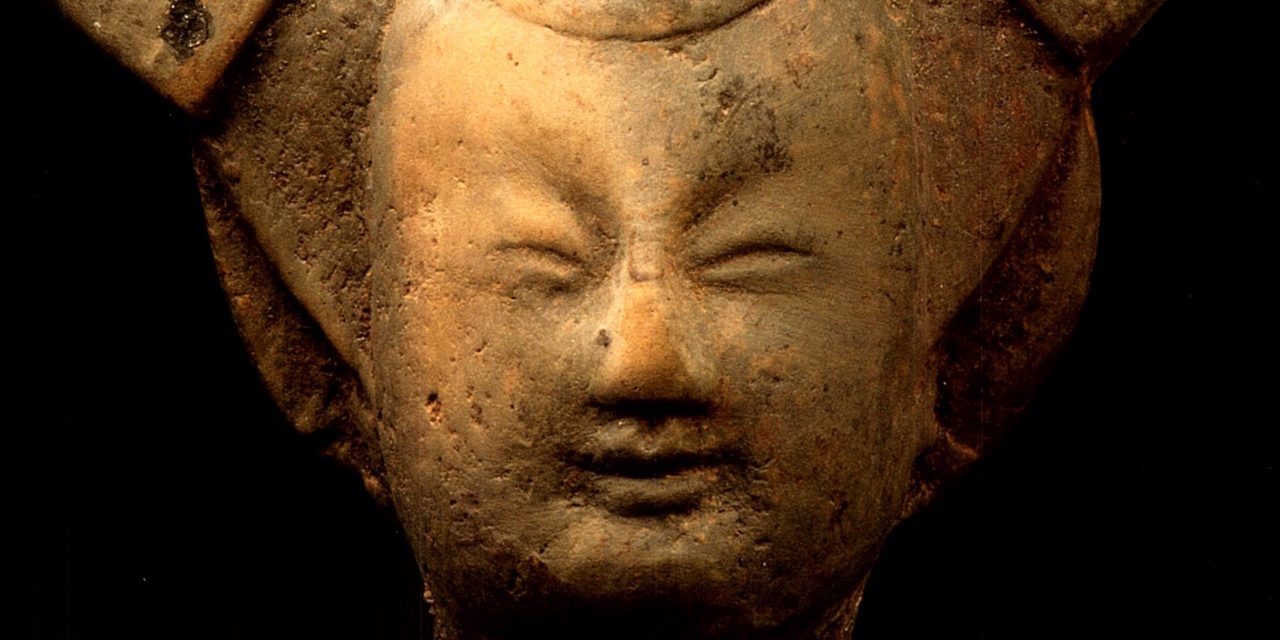
Featured Image: Pottery funerary figurine of a woman, 33.7 cm high, Eastern Jin (317-589 CE), unearthed in Nanjing, Jiangsu Province. The figurine depicts a maidservant with an amused expression.
O’Malley, Ottilee. Woman in Chinese. Independently Published, 2024. https://www.amazon.com/dp/B0DLTYZ6ZD?ref_=pe_93986420_774957520




 Donate
