The web of women writers revealed itself to me and my sister, Maria Dintino, after we had been writing about nasty women writers, artists, women of STEM and activists for some time. We began to see a rich weaving between women we had not known were connected. These woven threads span time and space and have many different forms that create a web of interconnectedness which becomes a source of support, nurturing and inspiration for those informed by it.
See our piece, Invisible Connections: The Hidden Web of Women Writers
As mentioned in the above post, some of the women on the web of women writers are so influential that they have formed large hubs around themselves and their work within the web of connectedness. Toni Morrison is one such powerful hub on the web of women writers.
Who influenced Toni Morrison?
It would be impossible to list all the women in the web of women writers that Black woman writer Toni Morrison influenced and continues to influence and inspire. Her reach is vast and shows up in unique and individual strains. But it is important to recognize it and attempt to shed light on the deliberateness of what Morrison sought to do and what she achieved. Morrison birthed her own powerful network whose connections continue to grow and inform the entirety of the web.
As one of her closest friends, writer and actor Fran Lebowitz writes:
“Toni was 88 when she died and I was 68. It is very difficult for anyone younger than I am to appreciate what a cultural earthquake she caused. Toni changed the whole idea of what an American writer was and could be. She was of a generation in which if you asked someone to imagine an American writer, that writer was, of course, a white man. Not any more. Not after Toni. She invented this thing that didn’t exist. Sometimes people get this ‘voice of a generation’ stuff thrust upon them, but they don’t really live up to it. Toni really did”(https://www.slow-journalism.com/from-the-archive/toni-morrison-as-remembered-by-fran-lebowitz).
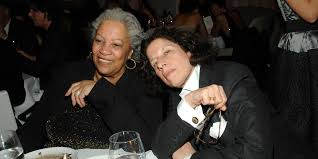
Toni Morrison and Fran Lebowitz
Lebowitz and Morrison were notorious for irritating people in the offices adjacent to Morrison at both Random House and Princeton University with their frequent, cigarette-smoke-filled conversations punctuated with uproarious laughter.
Reaching back to locate which women writers influenced Toni Morrison, we find references to her reading Jane Austen as a child. We know she was influenced by Virginia Woolf. As I wrote in Nasty Women Writers post: Virginia Woolf’s Far Reaching Network Within the Web of Women Writers
“Woolf holds a vast network of writers in her hub. One prominent woman writer who holds a vast hub of her own in the web and was hugely inspired by Virginia Woolf is Toni Morrison. I thought I recognized Woolf’s call to women writers to free themselves from the “male gaze” in Morrison’s call to Black writers to free themselves of the “white gaze” so I was not completely surprised to learn that Morrison had written her master’s thesis on Woolf and Faulkner.”
Doris Lessing is also mentioned as an influence along with Zora Neale Hurston, South African writer Bessie Head, and the folktales her parents told her. The influence of folktales looms large in Morrison’s personal literary oeuvre.
At the time of her undergraduate and graduate work, the works of Black women writers before her had yet to be reclaimed and republished. In other words, Toni Morrison didn’t have the benefit of Toni Morrison.
In The Source of Self-Regard, her 2019 book of essays, Morrison writes of her own awakening and education in finding writers whose influence she wanted to intentionally bring into the field.
“In 1965 I began reading African literature, devouring it actually. It was a literature previously unavailable to me, but then I had discovered a New York bookstore called Africa House, which offered among other things back issues of Transition, Black Orpheus, and works by a host of African writers from all over the continent. Amos Tutuola, Ayi Kwei Armah, Ezekiel Mphahlele, James Ngugi, Bessie Head, Christina Ama Ata Aidoo, Mongo Beti, Léopold Senghor, Camara Laye, Ousmane Sembène,Wole Soyinka, John Pepper Clark: the jolt these writers gave me was explosive. The confirmation that African literature was not limited to Doris Lessing and Joseph Conrad was so stunning it led me to secure the aid of two academics who could help me anthologize this literature. At the time African literature was not a subject to be taught in American Schools. Even in so-called world literature courses it had no reputation and no presence. But I was determined to funnel the delight, the significance, and the power of that literature into my work as an editor“(285).
Morrison understood that she would have to create what she didn’t have. By both bringing the voices of the past forward and developing the voices of the present and future. She knew she would have to encourage Black women writers to write in a new way, a way not beholden to the white gaze, a voice not self-conscious of their Blackness—voices true to themselves and their own experiences. This was not a cookie-cutter formula. There are many ways to experience Blackness in America. She wanted a variety to be published and made known.
She took this to heart for her own writing as well and brought us a radical new form and style in her 11 novels, 2 plays, and 9 books of essays.
Read Nasty Women Writers’ other posts on Toni Morrison:
Toni Morrison’s Sula: Available to and for her Own Imagination
Toni Morrison’s Beloved: A Woman Writer on Slavery and the Haunting that Persists
Toni Morrison’s Playing in the Dark: Whiteness and the Literary Imagination.
Toni Morrison as editor and teacher
 When she became the first senior Black woman editor in fiction at Random House in the late 60s, Toni Morrison slowly began to assert her authority and ambition to create a Black canon in American literature. She sought out, nurtured, edited, and published Black women writers, both fiction and non. In doing so, she brought forward some of the greatest voices of the time.
“Far from feeling adrift in her new position, Morrison embraced the fortuitous opportunity to help guide a major publisher during the period when the Black Studies movement in academia was in full swing. Books that could provide critical frameworks for analyzing systemic racism, empower readers through shared knowledge, and inspire communities to advocate for social justice were vital. She was at the center of a significant historical and cultural moment with little warning, and she stepped into her role with no hesitation. The culture at Random House offered her a unique opportunity to do this work”(Williams 28).
As mentioned earlier, Morrison set out to create a new literary canon. What is the literary canon? The following definition comes from the EBSCO website.
“The literary canon refers to a body of works that are widely regarded as essential reading within a culture, often serving as a benchmark for measuring literary quality. It encompasses texts deemed to represent significant contributions to human thought and artistic achievement”(https://www.ebsco.com/research-starters/literature-and-writing/literary-canon)
Morrison saw it this way:
“Canon Building is empire building. Canon defense is national defense. Canon debate, whatever the terrain, nature, and range (of criticism, of history, of the history of knowledge, of the definition of language, the universality of aesthetic principles, the sociology of art, the humanistic imagination), is the clash of cultures. And all of the interests are vested”(SSR 169).
 A.J. Verdelle, a woman writer that Morrison befriended and encouraged outside of Princeton and Random House, writes:
“Before she wrote, Morrison brought keen and substantial critical and narrative sensibilities to editing. She moved mountains of resistance and disregard, ushering in modern African American publishing. By documenting the movement and thinkers involved in social critique and literary production in the era before we bloomed into the canon, Morrison nurtured the renaissance that flowers around us now. Before we sprouted, we were seeds. . . . Morrison plied an intellectual currency that her industry had been indifferent to. A state of blindness that rendered her white colleagues bluntly unavailable to the authors she published and celebrated. . . . Morrison had a hand in unerasing us. Black people were shaking up, blowing up, glowing up. Wielding words as if in bloody bouts at the Colosseum in old Rome. Morrison presented a whole range of new Black thought, making scintillating new paradigms available for allies, and admirers and posterity. Morrison put new ideas, new strategies, and shifts in thinking on record. Morrison drew back the drapes on foment, expressed in argument, packaged in literature’s most respected form, the book”(Verdelle 56).
Read Nasty Women Writers post: Toni Morrison and A. J. Verdelle: For the Love of Words—the Connection Between Two Women Writers
In the New Yorker article, “Toni Morrison and the Ghosts in the House,” Hilton Als writes of how Morrison “fostered a generation of Black writers.” In the article, Morrison speaks to how it was a time of the civil rights movement and many activist groups were forming and gaining momentum. It wasn’t for her to be out on the streets protesting; she had her own way of contributing to change through her work as a writer and editor.
Thus, she began to originate and grow her node on the web of women writers, which continues to grow and prosper. One of the writers that Morrison nurtured, edited, and published in her time at Random House is Toni Cade Bambara (1939-1995).
Toni Morrison and Toni Cade Bambara
Bambara had already published two books The Black Woman (1970) and Tales and Stories for Black Folk (1971) when she and Morrison were introduced. Both books were anthologies of other people’s writing. She had also published her own stories in magazines, which Morrison admired. Morrison had a deep appreciation for Bambara’s writing style and could see how far Bambara could go as a writer, as well as how much she could do to increase the visibility of Black women writers. Morrison secured book deals for two collections of Bambara’s short stories, Gorilla, My Love (1972) and The Sea Birds Are Still Alive (1977), before encouraging her to write the novel, The Salt Eaters (1980).
Morrison’s promotion helped Bambara’s books garner good reviews and a large audience.
“A good writer, in Morrison’s view, could show the foolishness of racism without talking to or about white people at all. Authentic representation of Black life in America could do that work without remark.. . . a Black writer could write about Black life with no regard for the white gaze”(Williams 91).
Bambara’s writing excelled at this. She was a great match for Morrison to help her achieve her ambitions as an editor. And they became fast friends as well.
 Morrison encouraged Bambara to view her writing as activism, rather than consider her activism and writing in conflict with one another, an issue Bambara had been struggling with. She urged Bambara to prioritize her writing, even having her stay at her home to complete certain sections and go over final edits. Bambara shared Morrison’s desire to prove to publishers, agents and bookstores that there was indeed a market for Black women’s writing.
Bambara was the first Black woman writer Morrison brought on board to prove this point. And she was a perfect choice. Of Bambara’s writing, Morrison said: “Perfection seemed effortless in the writing”(Williams 86).
Bambara’s writing in turn influenced, inspired, and fostered another node on the web.
Read Nasty Women writers: Toni Cade Bambara: How to Care for Oneself while Healing the All
Though she had already left her position at Random House, Morrison collected and edited Bambara’s writing and interviews into the book, Deep Sightings & Rescue Missions: Fictions, Essays and Conversations (1996).
“Morrison imagined that fiction by Black authors could reflect the sophistication of Black culture in both style and content and that could speak directly to Black people in affirmative ways rather than as a response to whiteness. Having Bambara on her author list helped clarify how Morrison could uniquely impact the traditions of African American literature. . . . Recruiting Bambara in her early years as editor was all the good fortune she needed to prove to herself and to her fellow editors that she was up to the challenge of convincing others to join her cause”(Williams 110).
Further connections on Morrison’s network

One of Davis’s books edited by Morrison in her time at Random House
Angela Davis is another writer that Morrison nurtured, edited, and protected in her time at Random House. Morrison fought to keep Davis’s powerful voice when other editors wanted her to be softer and more compassionate. More apologetic. Davis has this to say about her mentor:
“This is why she was such an extraordinary editor at Random House: her defense of writers and their words. And it is in her editorial work where her political project is perhaps most explicit. Before her own writing career was established, she edited the writings of Toni Cade Bambara, June Jordan and Gayl Jones, and so many others who might not now be available to us if she had not challenged the publishing industry on their behalf”(https://www.nytimes.com/2019/08/07/opinion/angela-davis-toni-morrison.html)
In her time teaching at Princeton and other institutions, Morrison influenced writers and scholars, including Mackenzie Scott(famously introducing her to her future husband Jeff Bezos), Julia Leigh, Autumn Womack, Imani Perry, Kaitlyn Greenidge, Farah Jasmine Griffin, and Rachel Kadish.
Read Nasty Women Writers post, Rachel Kadish: Transcendence and Text
Writer Roxane Gay writes:
“Everything I am and ever will be as a black woman who writes begins with the work of Toni Morrison. My words have been shaped by all of her work. . . But, perhaps, her greatest legacy will be the direct lineage between her and so many black writers who are following in her footsteps as they create their own legacies. She broadened the scope of what I thought was possible for myself as a writer and a woman. I can never repay that gift”(https://www.nytimes.com/2019/08/09/opinion/roxane-gay-toni-morrison.html)
So many she influenced, so many she inspired. The web of women writers is forever changed for the better by Toni Morrison.
©Theresa C. Dintino 2025
Works Cited
Morrison, Toni. The Source of Self-Regard: Selected Essay, Speeches, and Meditations. Vintage, 2019.
Williams, Dana, A. Toni at Random: The Iconic Writer’s Legendary Editorship. Amistad 2025.
Verdelle, A.J. Miss Chloe: A Memoir of a Literary Friendship with Toni Morrison. HarperCollins, 2022.
 Donate